Eden Prairie Wood Flooring has installed, sanded and refinished wood flooring in Chanhassen for more than 20 years, and every job here opens the same way: with a hygrometer reading taken inside the house and written down before anything is quoted. A heated Minnesota home in January routinely sits below the thirty to fifty percent relative humidity band solid wood flooring is specified for, and that single number explains most of what a floor does between Thanksgiving and April.
That reading starts a conversation rather than a humidifier setting handed over at the door. Pushing indoor humidity up toward what the floor wants can put condensation on your windows during a cold snap, so we say out loud where the tradeoff falls in your house and leave the setting to you.
The rest of the work is measured the same way. Moisture content of the flooring and of the subfloor are read against each other before a board goes down, both numbers land on the paperwork, and a written grit sequence and finish schedule come with the quote so the finished floor can be checked against something.
One city, two counties, and why that is more than trivia
Chanhassen sits in Carver County with a small portion of the city extending east into Hennepin County, and it is split between two school districts: Eastern Carver County Schools, ISD 112, with northern sections in Minnetonka Public Schools, ISD 276. Homeowners here are used to checking which line an address falls on before they call anyone about anything. For flooring work, the answer is simpler than the map makes it look.
Who administers the code
Whichever county an address lands in, the work is governed by the Minnesota State Building Code, Minnesota Rules chapters 1300, 1303, 1305 and 1309, as administered by the City of Chanhassen. One city hall, one set of rules, on both sides of the county line.
What that means for a floor job
Most of what we do is finish work, and Minnesota Rules 1300.0120 exempts finish work from the permit requirement. Replacing a floor, sanding one back to bare wood or repairing a damaged section is not normally a permit conversation. Where flooring is one part of something larger, such as a lower-level buildout or a structural repair, the permit follows that larger project rather than the floor.
Buildings with an association have a second rulebook
Where a home sits in a building with shared ownership, the Minnesota Common Interest Ownership Act and the association’s own declaration and bylaws under Minnesota Statutes 515B sit on top of the building code, and they usually have something to say about hard-surface flooring. We read the governing documents and specify the acoustic underlayment to that building’s impact insulation class and sound transmission class requirements before an upstairs job goes on the schedule, rather than finding out at the first complaint from below.
The one number people expect to differ
Frost depth is the code figure homeowners assume changes at a county line. It does not change here: Carver County and Hennepin County are both named in Minnesota Rules 1303.1600 Zone II, where the minimum allowable footing depth due to freezing is three and one-half feet. Both halves of the city sit under the same footing rule, which is worth knowing when a three-season porch is being brought inside and floored to match the rooms next to it.
Looking for wood-flooring closer to Shakopee? See Wood-Flooring Services in Shakopee.
A 1990s stock now reaching its first full sand-and-refinish
The largest single build cohort in Chanhassen is the 1990s, at 27.5 percent of 10,186 housing units, with another 33.7 percent built in 2000 or later. This is a city where a very large share of the wood floors went down inside one stretch of years, which means a very large share of them are arriving at the same decision at roughly the same time.
With 84.1 percent of occupied housing units owner-occupied, these are mostly floors people have lived on themselves for decades rather than turned over. Thirty years is well past the recoat window in a kitchen path or the run from the garage door to the island, even where the bedrooms still look close to new.
Recoat, or sand back to bare wood
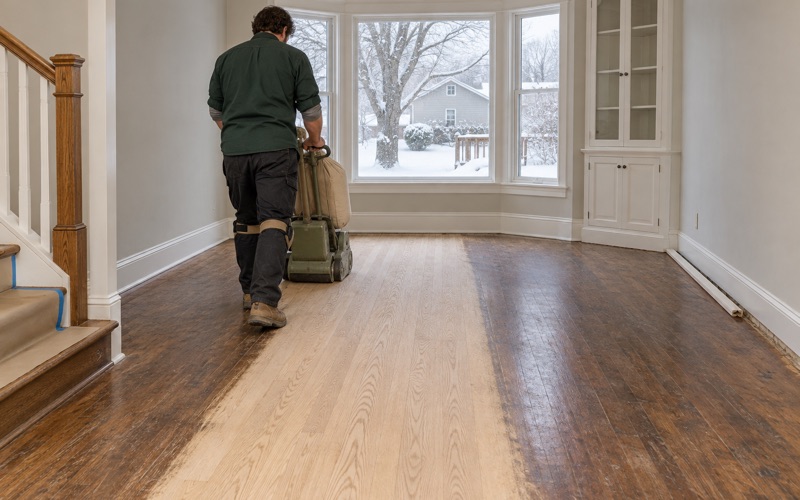
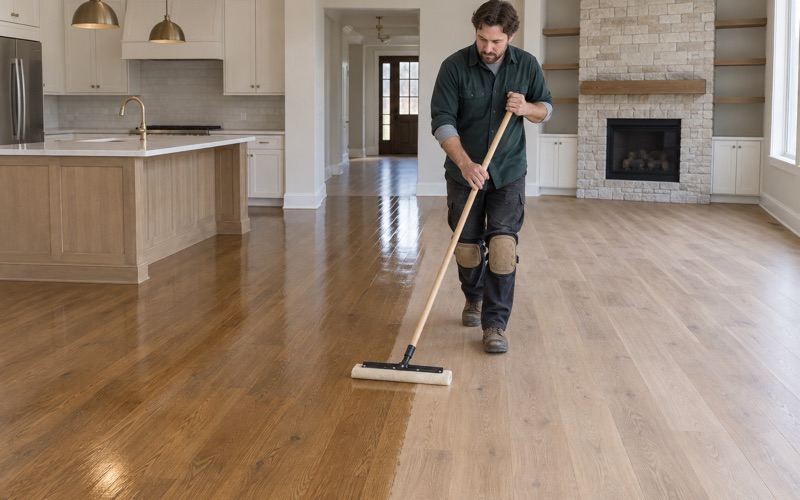
A screen-and-recoat abrades the existing finish with an abrasive screen and puts a fresh coat over it. It is faster, cheaper and far less disruptive, and it works only while the finish is worn rather than worn through. Once the traffic lanes have reached the wood, the gray and the stain read straight through a new coat and the honest answer is a full sand.
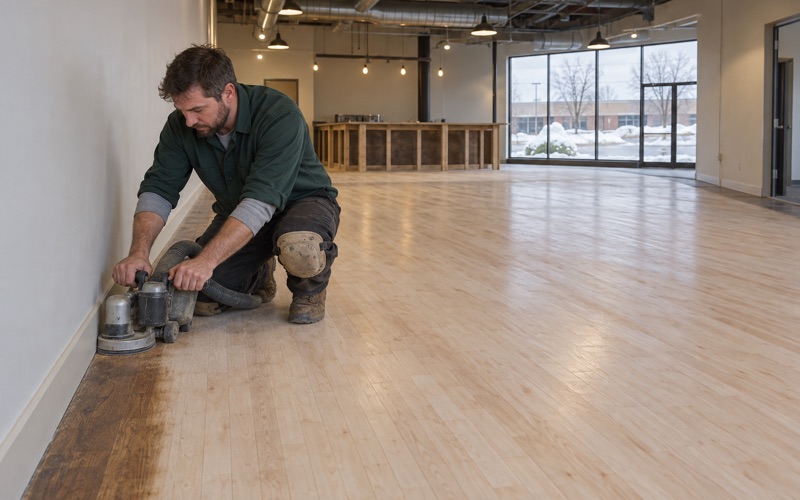
A full refinish here is a 36-50-80 grit sequence run with a drum sander, an edger and a buffer, followed by the finish schedule we wrote into the quote. We price the recoat against the full job on the same sheet, including the cases where the cheaper answer is the right one, because a recoat sold as a refinish shows itself within a season.
Engineered floors get the wear layer measured first
A large share of what went into this cohort is engineered rather than solid, and engineered core construction sets a hard limit on how many times a floor can be sanded. We measure the wear layer before quoting any refinish, because past a certain thickness there is nothing left to take off and the attempt ends in sand-through along the edges and the seams. Where the material is not there, we say so and price a recoat or a replacement instead of selling a sanding that cannot succeed.
When the answer is new flooring instead
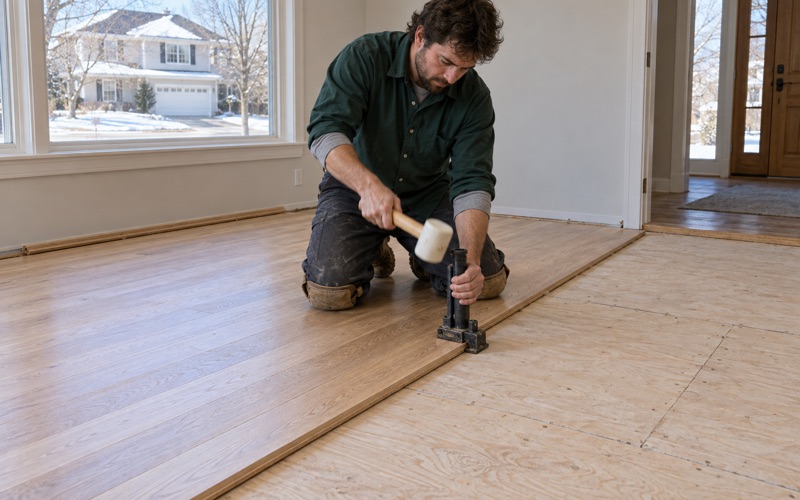
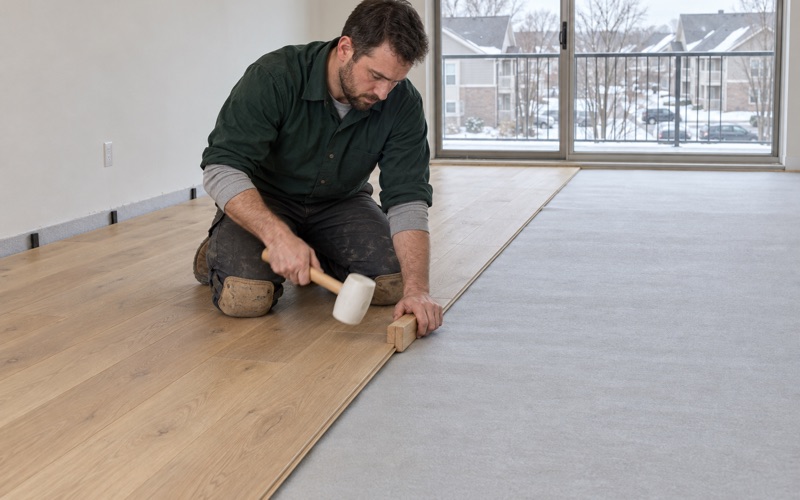
Where a floor is past sanding, the choice between site-finished and prefinished is worth putting on paper. Site-finished white oak or red oak gives a flat, seamless surface and a sheen level chosen in your own light, while prefinished puts the household back on the floor sooner. Either way the material acclimates on site first, and we read its moisture content against the subfloor to the tolerance the NWFA installation guidelines set before any of it is fastened down.
Wooded and lake-adjacent lots, and what sits under the floor
Chanhassen’s subdivisions were platted and named for the lakes and creeks they sit on, and much of the city drains through the Riley-Purgatory-Bluff Creek Watershed District. The consequence for flooring is grade. Sloped, wooded lots produce walkout and lookout lower levels, and a finished lower level is a below-grade installation however bright the windows make it feel.
Heating matters as much as grade down there. A forced-air system running hard from December through March pulls a lower level well under the humidity range solid wood is milled for, and a whole-house humidifier on a humidistat is the usual counterweight. We take the reading with the system running the way you actually run it, not on a mild day with the furnace idle.
The slab reading comes from the slab
Concrete gives up moisture for a long time, and a reading taken on the main floor says nothing useful about the slab underneath the lower level. We test that slab itself, with a calcium chloride test or an ASTM F2170 in-situ relative humidity probe, and the number decides the vapor retarder and its perm rating, the adhesive, and whether a solid floor belongs down there at all. Every below-grade quote we write is built on a reading taken on the slab in question.
When the water arrives from somewhere else
Sump pump failure and ice dam runoff are the two events that most often put standing water on a finished floor here, and both are insurance conversations before they are flooring ones. We photograph and moisture-map the damage for the claim before any drying or tear-out begins, because once a wet floor has been pulled up, the evidence that would have supported a like kind and quality replacement has gone out with it.
Cupping in February is not always a defect
Cupped edges in the coldest weeks usually mean a moisture content differential across the thickness of the board rather than bad flooring. Dry cupping and seasonal gapping both track the indoor humidity swing, and a good share of the gap you can set a coin edge into in February has closed again by June. We measure and photograph winter gapping before anyone calls it a failure, then set a date to look at the same boards in summer.
The settlement core, and the handful of genuinely old floors in it
Only 1.3 percent of Chanhassen’s housing units were built before 1940, and 7.0 percent before 1960, so the genuinely old floors here are a small and specific set rather than a neighborhood. The area was first settled in June 1852, and the city’s name comes from a Dakota word for the sugar-maple tree.
Chanhassen incorporated as a village on April 25, 1896 and became a city on May 8, 1967, when it merged with Chanhassen Township. The Church of St. Hubertus-Catholic is an 1887 church carrying a historic listing dated March 19, 1982, and a Franciscan brotherhood platted and grew the German Catholic settlement around it; the Albertine and Fred Heck House, a circa-1895 farmhouse built of distinctive local brick, was listed on December 27, 2000.
What an old floor actually needs
Floors of that age are usually narrow strip white oak or red oak, sometimes quartersawn, milled thinner than anything sold today and often sanded once or twice already. The first question is how much wood is left above the tongue, and the answer decides whether the floor gets sanded again or gets a careful repair and a coat instead.
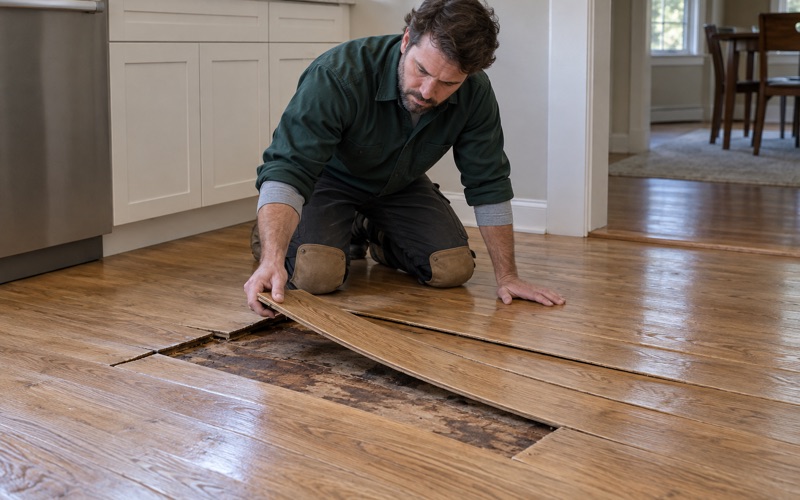
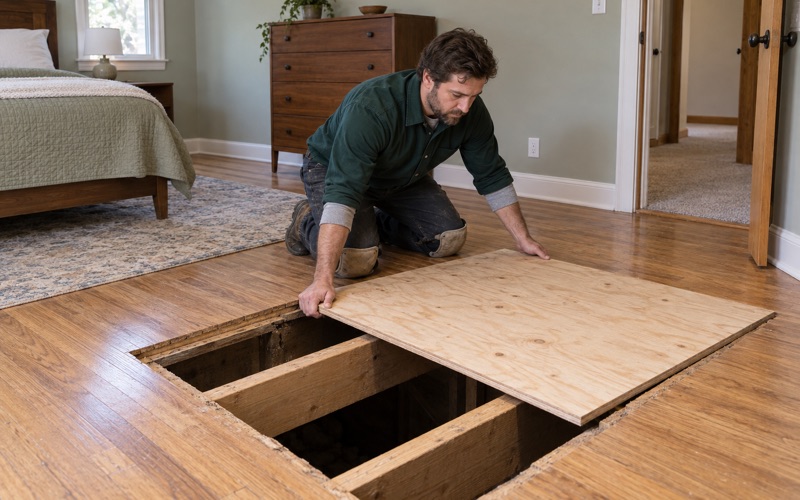
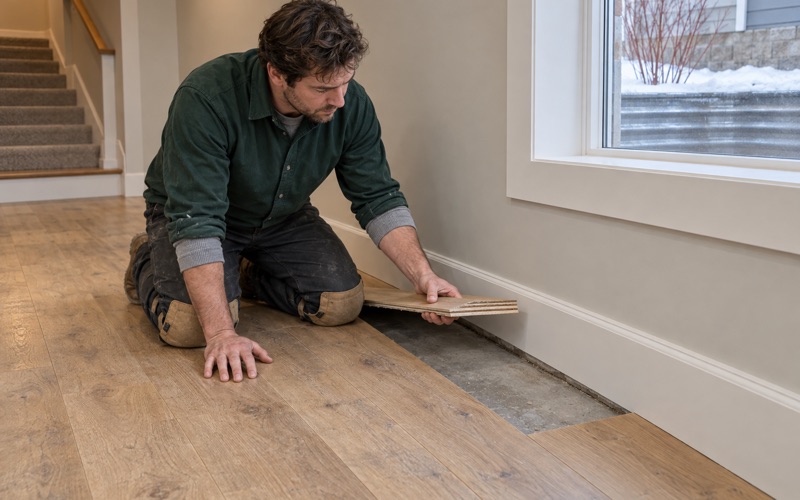
Repairs in this stock are board replacement woven into the existing field, with a weave-in or lacing at the edges of the patch and a dutchman where one defect is cut out, rather than a square of new floor dropped in and bordered. Squeaks and nail pops over an old plank subfloor are usually fastener and framing problems, fixed from below where there is access, with joist sistering when the deflection warrants it.
Dust, lead and cure time
Housing built before 1978 falls under the EPA RRP lead-safe rule, which governs how painted surfaces are disturbed during renovation work. On a floor job in a house of that age it means the trim, the containment and the cleanup are planned before the first machine starts, and that a HEPA-shrouded sander does the sanding.
The finish is the last thing that should be rushed. Cure time is not dry time: a waterborne polyurethane is walkable long before it is durable, and a cold January house stretches both numbers. We hand over return-to-service times in writing, separately for foot traffic, for furniture and for rugs, and we plan around the pets and where the household is sleeping before anything is moved.
- 20+ Years Experience
- Free Written Quotes
- Moisture Readings on Every Quote