
Eden Prairie Wood Flooring installs, refinishes and maintains commercial wood flooring in Eden Prairie, MN, with 20+ years of trade experience behind it. Commercial work here runs from southwest metro restaurants and taprooms to corporate campus buildings, schools, churches and multi-tenant offices, and it shares only its material with residential work. Everything else about it is different.
The differences are traffic, schedule and consequence. A commercial floor takes in a month what a house takes in a year, so the specification has to be chosen for wear rather than for appearance alone. The work has to fit around trading hours, class timetables or service times. And a floor that is not ready on the reopening date costs the business money in a way that a delayed hallway at home does not.
So commercial quotes from us carry a phasing plan alongside the specification: which areas are done in which order, what hours the noisy work happens in, what the containment is, and the dry and cure times with the reopening date worked backward from them. The written grit sequence and finish schedule come as standard, because on a commercial job several people need to be able to check the work against the same document.
Commercial Spaces We Work In
Restaurants, Taprooms and Hospitality Floors
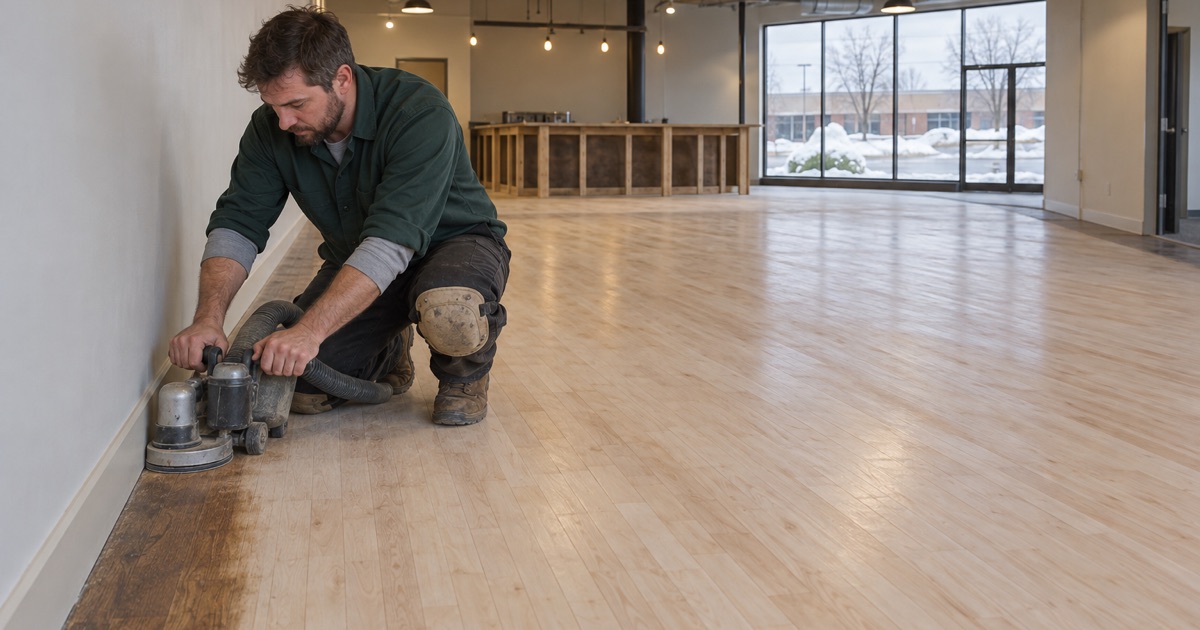
Dining rooms and taprooms take chair drag, spills, grit carried in from a parking lot and constant foot traffic across a few defined lanes. The floor is also part of the room’s appearance, so wear shows commercially as well as physically. We specify for the traffic rather than the photograph, plan the work around closed days, and build the coats where the lanes actually are.
Offices, Corporate Campuses and Conference Rooms
Office wood flooring concentrates its wear at entries, elevator lobbies and under chairs, and its work has to happen without disrupting the tenants next door. Sound, dust and access all get planned with building management before we start. We also account for the reality that an office floor is looked at closely by clients, so consistency across a large open area matters.
Schools, Churches and Assembly Spaces
These buildings offer real windows — a summer break, a week between terms, a weekday in a building used mainly at weekends — and almost no flexibility around them. We schedule to the window rather than to our convenience, use finishes whose cure times fit it, and confirm in writing when the space can carry chairs, tables and people again.
Specification for Commercial Traffic
Species, Janka Hardness and Wear
Janka hardness measures resistance to indentation and is a fair way to compare species, with white oak and hard maple the usual commercial choices. It is not the whole story: dent resistance and abrasion resistance are different properties, and the finish carries much of the second one. We use hardness as one input alongside finish specification, matting and the maintenance plan.
Commercial Finishes and Conversion Varnish
Commercial finish specifications reach further than residential ones, from high-solids waterborne systems to conversion varnish where the traffic justifies it. Each brings its own cure schedule, odor profile and recoat behavior, and some are unsuitable for an occupied building. We name the product, its cure time and its recoat window in the quote so the operating plan can be built around real constraints.
Site-Finished Against Prefinished in a Busy Space
Prefinished flooring removes sanding and coating from the site, which in an occupied building can be decisive. Site-finished work produces a continuous surface, allows the exact color, and makes future refinishing simpler, at the cost of machines and cure time in the space. On a commercial job that choice is usually made by the calendar rather than by preference, and we price both.
Working Around an Operating Business
Phasing, Nights and Closed Days
Most commercial floors get done in sections so the business keeps running. We set out the phases, the barriers, the route customers or staff take past the work, and the sequence of finishing so no area is stranded. Where night work or a closed day is the better answer, we say so early enough for it to be scheduled rather than improvised.
Dust Containment and Adjacent Tenants
Vacuum-shrouded drum sanders, edgers and buffers take the majority of the dust at the tool, and in a commercial setting we add sealed containment at the boundary, negative pressure where appropriate, and protection along the access route. Neighboring tenants are told what happens on which day. That communication prevents more complaints than any single piece of equipment does.
Cure Times Against a Reopening Date
A finish that is dry is not a finish ready for tables, racking or a delivery cart. Cure is the number the reopening date depends on, and it stretches in a cool building. We schedule backward from your date, choose products whose cure fits it, and hand over the times in writing rather than leaving a manager to judge by touch on the morning of a reopening.
Maintenance That Keeps a Floor Out of a Refinish
Recoat Cycles on a High-Traffic Floor
The cheapest way to run a commercial wood floor is to recoat it before the finish wears through. A screen-and-recoat takes essentially nothing off the wood, restores the surface in a short window, and can be repeated for years. Set against an unplanned full sand that closes a dining room, a scheduled recoat is both cheaper and far easier to plan around.
Entry Matting, Grit and Chair Wear
Most commercial floor damage arrives on the soles of shoes. Adequate walk-off matting at every entry removes a large share of the grit that does the abrading, and felt or proper glides on chair legs handle much of the rest. We say what matting length and what chair protection the space needs, because that advice extends the recoat cycle more than any upgrade to the finish.
Moisture and Slab Conditions in Commercial Buildings
Commercial construction is frequently slab-on-grade, and the slab governs what can be installed and how. We test it in the space with an in-situ relative humidity probe or a calcium chloride test, specify the vapor retarder and adhesive from that reading, and re-check before a refinish where a floor has cupped without an obvious cause. A slab still giving off moisture will defeat any finish applied over it.
- 20+ Years Experience
- Free Written Quotes
- Moisture Readings on Every Quote