
Eden Prairie Wood Flooring handles engineered hardwood floor refinishing in Eden Prairie, MN, with 20+ years of sanding and finishing behind the work. Engineered floors are common here for good reasons — they are stable through a Minnesota humidity swing and they are the right product over a lower-level slab — but refinishing one is a different job from refinishing solid wood, and it starts with a measurement rather than a quote.
An engineered board is a wear layer of real hardwood bonded to a plywood or composite core. Everything a sander can touch lives in that top layer, and it varies from a substantial sawn veneer to something thin enough that one aggressive pass would go through it. The board looks identical from standing height either way, which is exactly why so many engineered floors get quoted for a full sand they cannot survive.
So we find the wear layer before anything else: at a register cut, a threshold, a stair nosing or a leftover board from the original job. Then we say which of three things your floor is a candidate for — a light sand within the veneer, a screen-and-recoat, or neither — and we quote that. Where the honest answer is the cheaper one, that is the one we recommend.
Whether Your Engineered Floor Can Be Refinished
Measuring the Wear Layer
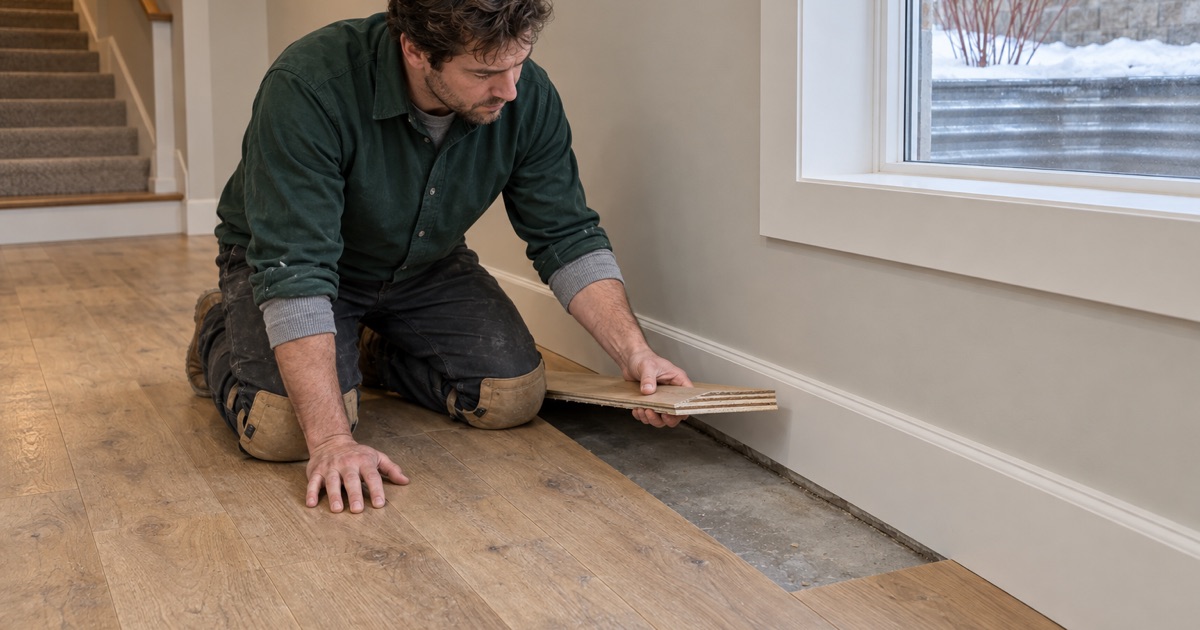
The measurement is the whole decision. We look at an exposed board edge wherever the house already provides one, and where nothing is exposed we lift a single board in a closet and put it back. A generous sawn veneer gives room for a real sand; a thin one does not, whatever the finish looks like on top. Where only the manufacturer’s published specification is available, we say that is what the quote rests on.
Sawn, Sliced and Rotary-Peeled Veneers
How the veneer was cut from the log matters as much as how thick it is. Sawn veneer is cut like solid lumber and behaves like it under abrasive. Sliced and rotary-peeled veneers are taken off a rotating log with a blade, which is efficient and produces thinner, less forgiving material. Knowing which one is on your floor tells us how the surface will take sanding and how much margin there is.
Lathe Checks and Why Some Veneers Sand Badly
Rotary-peeled veneer often carries fine cracks left by the peeling blade, known as lathe checks, running along the face. They stay invisible under a factory finish and can open up once the surface is abraded and recoated, showing as hairline lines across the grain. We check for them before recommending a sand, because a floor that develops them afterward has been made worse rather than better.
Sand, Screen or Recoat
A Light Sand Within the Wear Layer
Where the veneer allows it, a sand removes scratches, water marks and the old finish and lets the floor be stained or coated fresh. The difference from solid wood is margin: the sequence is planned to take the minimum that will do the job rather than the coarsest grit that works fastest. We write the grit sequence into the quote, as on any refinish, and check the floor under raking light before finishing.
Screen-and-Recoat on a Sound Finish
A screen-and-recoat abrades the existing finish just enough for a new coat to bond and takes essentially nothing off the wood. It is the right answer on a floor whose wear has not reached the veneer, it is far less disruptive, and it can be repeated over the years. It will not remove deep scratches, lift staining or change the color, and we say so rather than letting anyone expect a full refinish for recoat money.
What a Sand-Through Looks Like and Why It Cannot Be Fixed
Once a sander has cut through the veneer, the core beneath is exposed as a pale patch that takes stain and finish completely differently from the boards around it. No further sanding will remove it, because sanding is what produced it. The repair is board replacement, which on a discontinued product can be genuinely difficult. That single failure is the reason the wear layer is measured before the machines arrive.
Equipment and Technique on a Thin Veneer
Orbital and Buffer Work Instead of a Drum
On a thin veneer, a drum sander removes more material than the floor can spare, so the work moves to an orbital sander and a buffer with an abrasive screen where the wear layer is tight. It is slower, and on the right floor it is the difference between a refinished surface and a ruined one. We match the machine to the measurement rather than to the schedule.
Edges, Bevels and Prefinished Micro-Bevels
Most prefinished engineered boards carry a micro-bevel along each edge. Sanding the floor flat removes the bevel in the sanded area, which changes the look from a series of defined planks to a continuous surface, and it is not reversible. Some people prefer the result and some do not. We show you what to expect, and we plan the edge work so the perimeter does not read as a band.
Flatness, Overwood and the Limits of a Floating Floor
A floating engineered floor moves slightly under a machine, which makes flat, even sanding harder than on a nailed or glued floor and increases the chance of overwood at the joints. Where the floor floats over an acoustic underlayment, that flex is by design. We check how the floor is fixed before quoting, because the installation method changes both the technique and what is realistically achievable.
Where Engineered Floors Usually Live
Lower Levels and Slab-On-Grade Rooms
Engineered flooring is the product for a lower level, where solid hardwood is not recommended, so a great many of the engineered floors we look at are below grade. Before refinishing one we read the slab as well as the floor, because a surface that is still taking on moisture from the concrete will not hold a new finish. That reading also explains a floor that has cupped without any visible leak.
Radiant Heat and Attached Homes
Engineered construction suits hydronic radiant floor heat and is frequently what an association’s specification requires in an upper-level unit over an acoustic underlayment. Both change how a refinish is scoped: radiant systems need managing through the work, and in an attached building the association may have something to say about any change to the assembly. We check both before the quote rather than during the job.
Finishes That Suit a Factory-Coated Surface
Factory finishes are cured under ultraviolet light and are harder than anything applied on site, which affects how the old coating is broken and what bonds to it. Waterborne polyurethane is the usual choice for its fast cure and clarity, and hardwax oil suits a floor whose owner wants spot repairs rather than whole-floor recoats later. We name the product and its dry and cure times in writing.
- 20+ Years Experience
- Free Written Quotes
- Moisture Readings on Every Quote