
Eden Prairie Wood Flooring has been doing hardwood floor repair in Eden Prairie, MN for 20+ years, serving surrounding cities including Chanhassen, Shakopee, Edina, Minnetonka and Hopkins. We repair solid and engineered floors on every level of the house, from a few boards taken out by a dishwasher leak to a whole room that has cupped, buckled or been worn through to bare wood.
Repair covers more ground than most people expect. It includes board replacement and weave-in, dutchman patches around a removed wall or vent, squeaks and nail pops, loose and hollow-sounding boards, pet and water staining, sand-throughs left by previous work, and the diagnosis that decides which of those you actually have. Some of that is carpentry and some of it is moisture, and getting the second one wrong is how a floor gets repaired twice.
So every repair here starts with numbers rather than an opinion. We put a moisture meter across the boards and into the subfloor, read the indoor relative humidity with a hygrometer, and write both on the quote alongside the scope. In a metro where a furnace-heated house in January sits well under the thirty to fifty percent relative humidity band wood flooring is specified for, knowing where your house actually sits is what separates a board that needs replacing from a board that is going to come back on its own.
Hardwood Floor Repairs We Take On
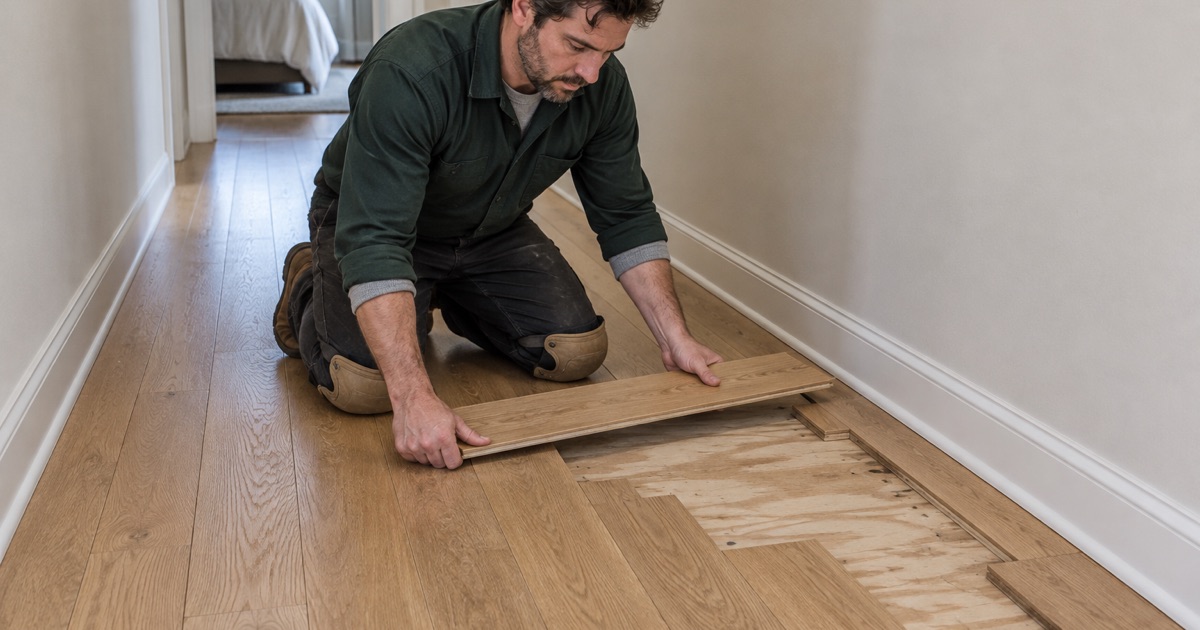
Board Replacement and Weave-In
Damaged boards come out individually and new stock goes back in, with the joints staggered into the surrounding field rather than stopped in a straight line at the edge of the repair. A weave-in takes longer than a square patch and is the difference between a repair you cannot find and one that is visible from the doorway for the life of the floor. Where a run of boards has to come out, we lace the new work into three or four courses on each side.
Dutchman Patches and Localized Damage
A dutchman is a shaped piece let into the existing board rather than a whole board replaced, and it is the right answer for a burn, a deep gouge or a stripped-out fastener hole in the middle of a plank worth keeping. We cut to the grain direction so the seam falls where the eye does not look for it. It suits floors with limited remaining thickness, since it avoids opening the tongue-and-groove joint of a neighboring board.
Squeaks, Nail Pops and Loose Boards
Most squeaks are the subfloor moving against a joist or a fastener working loose, not the finish flooring failing. Where there is access from below we screw the plywood or OSB subfloor down and shim the gap at the joist, which fixes the noise without disturbing the floor at all. From above we fasten and fill, or replace a board whose tongue has broken, and we say which squeaks are structural before promising silence.
Diagnosing Cupping, Crowning and Buckling
Dry Cupping in the Heating Season
Dry cupping is the boards losing moisture and pulling in at the edges, and it belongs to the heating season rather than to a leak. We read the moisture content across the width of several boards and compare it to the indoor relative humidity, then measure again after the humidity recovers. A floor that flattens as the house comes back up through spring did not need a repair, and photographing it in February is what keeps that conversation short.
Cupping Over a Wet Subfloor
Cupping driven from underneath looks much the same from standing height and behaves completely differently. Here the underside of the board is wetter than the face, and the moisture content differential between the flooring and the subfloor tells us so within minutes. We find the source first, whether that is a slow supply leak, a dishwasher pan, a sump that has been overwhelmed or vapor coming up through a slab, because sanding a floor that is still taking on water is money spent twice.
Buckling and Compression Set
Buckling is the floor lifting off the subfloor entirely, and it usually means the boards ran out of room: an expansion gap that was too tight, a floor installed at heating-season moisture content and never acclimated to the range the house sees, or a wet event. Compression set is the quieter version, where boards crushed against each other in summer leave permanent gaps in winter. Both are diagnosed at the perimeter and at the fasteners rather than in the middle of the room.
Matching an Existing Floor
Species, Grade and Sawing Pattern
A convincing repair starts with identifying what is already down: red oak against white oak, hard maple against hickory or American walnut, plainsawn against quartersawn or rift-sawn, and the actual board width rather than the nominal one. We pull a board and check before ordering anything. Sourcing the wrong grade is the single most common reason a technically sound repair still reads as a patch from across the room.
Site-Finished Against Prefinished Boards
A site-finished floor can take a new board sanded flat with the field and coated as one surface. A prefinished floor has a micro-beveled edge and a factory finish that cannot be sanded flat without removing the bevel from everything around it, so the repair strategy is to match the product or to accept a visible line. We tell you which one you have and what each route realistically looks like when it is done.
Blending a Repair Into an Old Finish
An existing floor has ambered, worn and been cleaned for years, and new wood arrives without any of that history. We test stain and sheen on the new boards against your floor rather than against a sample card, and we recommend a full-room sand when the blend will not hold up in daylight. Sheen level matters as much as color here, because a repair that matches in shade and not in gloss still catches the eye.
Repairs in Townhomes, Condos and Lower Levels
Upstairs Units and Association Documents
In an attached home, the repair may be governed by the building’s declaration and bylaws before it is governed by anything else, and some require an approved underlayment specification even for partial work. We read those documents for your building first, because Minnesota does not set a single sound rating that settles it. Getting the specification approved before a crew is booked is what keeps a repair from becoming a rescheduled job.
Below-Grade and Lower-Level Repairs
A lower level has its own humidity, and a repair down there gets quoted from a reading taken on the slab itself rather than from the main floor. Solid hardwood is not recommended below grade, so where a lower-level floor has failed we look at what is actually installed before deciding whether to repair in kind or to recommend engineered flooring over a suitable vapor retarder. Quoting the basement off an upstairs number is how the same floor fails twice.
Water-Damaged Rooms and Partial Replacement
Where a leak took out part of a floor, the scope question is how far the water traveled rather than where the staining stopped. We map moisture readings room by room and photograph everything before drying or tear-out begins, which is also what an insurance claim needs. Then we replace what is wet, dry what can be saved, and weave the new work into the dry rooms so the finished floor reads as one surface.
Our Step-by-Step Hardwood Floor Repair Process
Readings, Photographs and Diagnosis
The first visit produces a moisture reading across the boards, a reading in the subfloor, an indoor relative humidity figure and photographs of the damage at its current state. That record is what the repair is designed against, and on a water claim it is the only version of the floor anybody will be able to look at later.
A Written Scope and Quote
The quote names the boards to be replaced, the source of the replacement stock, whether the repair ends in a spot blend or a full-room sand, the grit sequence if sanding is involved, and the finish. Anything conditional is written as a condition rather than discovered mid-job, so there is a document the work can be checked against.
Removal, Replacement and Subfloor Work
Damaged boards come out without disturbing the neighbors more than necessary, the subfloor is inspected, dried, screwed down or repaired as required, and the new stock goes in woven into the existing courses. Fastener type, gauge and spacing follow the flooring rather than whatever is in the gun.
Sanding, Finishing and Cure
Where the repair ends in sanding, we run the written grit sequence with dust containment, apply the agreed finish, and hand over dry and cure times in writing. Cure is the number that decides when rugs, furniture and pets come back, and a cold house in January extends it.
- 20+ Years Experience
- Free Written Quotes
- Moisture Readings on Every Quote