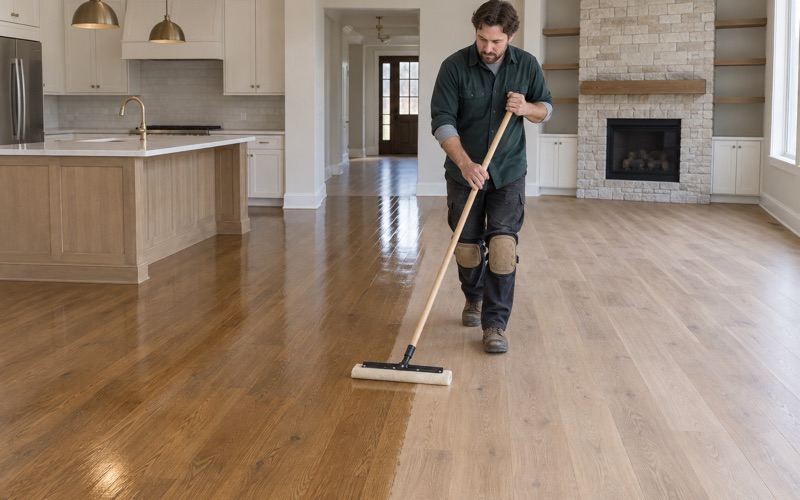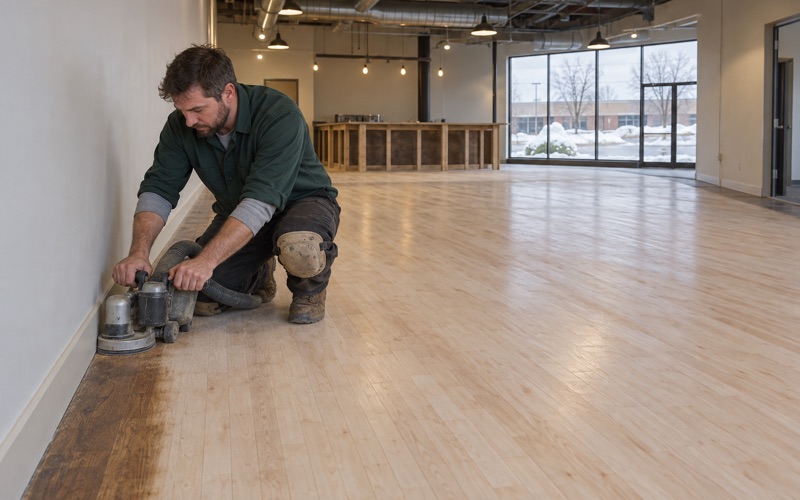
Eden Prairie Wood Flooring has been installing, sanding and finishing wood flooring in Prior Lake for more than twenty years, and the houses here ask for something particular. Almost every floor we are called out to look at sits in a home somebody lives in all year. What we quote is maintenance on a surface that has to keep working, not a fast cosmetic reset before the next set of feet arrives.
That shows up first in how we start. We read the indoor relative humidity with a hygrometer on the first visit and write the number down, because a heated Minnesota house in January usually sits under the thirty to fifty percent band wood flooring is specified for. Before a board goes down we also take the moisture content of the flooring and of the subfloor and compare them against each other, and both numbers go on the paperwork.
You get a written grit sequence and finish schedule with the quote, so the finished work can be checked against something rather than against a memory of a conversation. And if a screen-and-recoat will do what you actually want, we say so and price it against a full sand-and-refinish, including the times the cheaper answer is the right one.
A city that closed the door on short lets
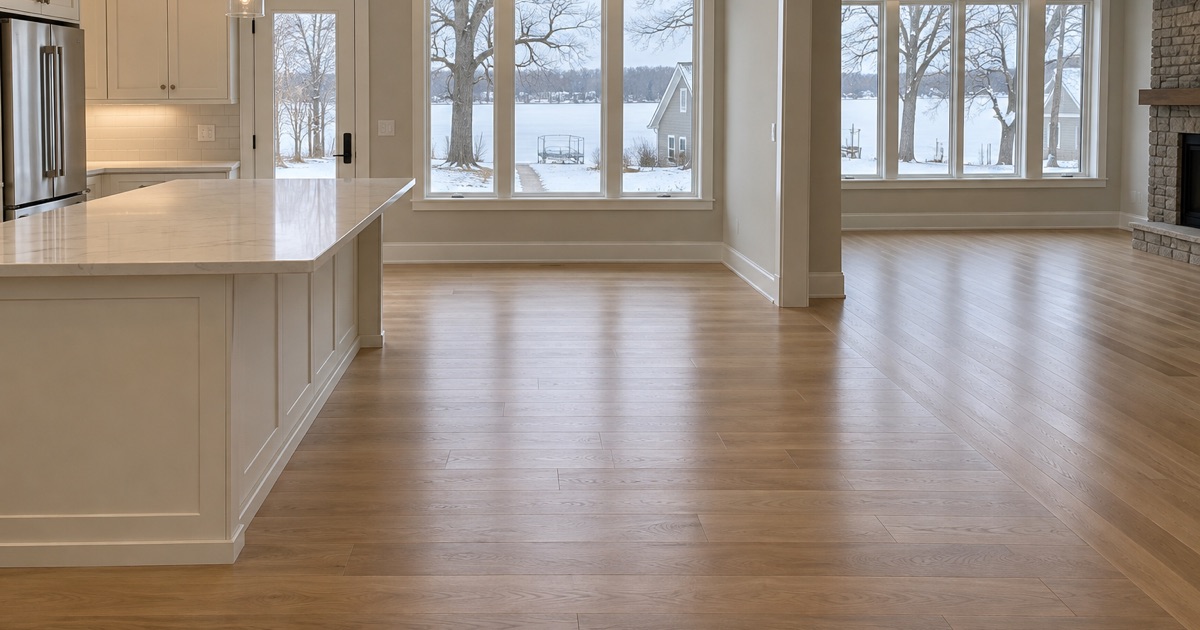
Prior Lake’s city code prohibits renting a dwelling unit for fewer than sixty days in every residential use district, and a rental of at least sixty days but not more than 180 requires a permit. The practical effect on a floor is that its wear arrives from one household over years rather than from a rotating cast over a season.
The ownership numbers point the same direction. Of 9,976 occupied housing units, 8,602 are owner-occupied, or 86.2 percent. That is a city full of people who will still be standing on the same boards in ten years, and it changes which of two quotes is the honest one.
Where a floor is going to change hands quickly, the cheapest coat that photographs well tends to win. Where the owner stays, the finish schedule matters more than the first impression, and so does whether there will be anything left to sand a decade from now. We quote for the second case here because it is nearly always the one standing in front of us.
What that changes about a maintenance coat
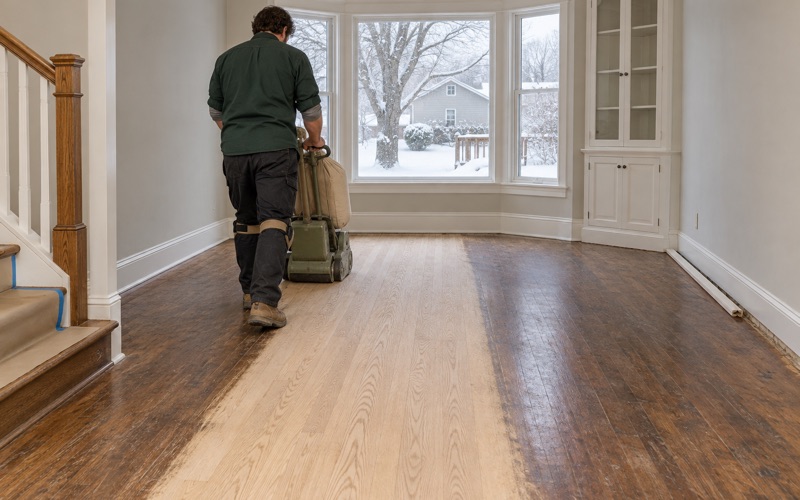
A floor caught inside its recoat window, before the finish is worn through to bare wood anywhere, never needs the aggressive work at all. An abrasive screen, a buffer and a fresh coat of waterborne polyurethane is a day rather than a week, and it costs a fraction of a full sand.
Miss that window and the answer becomes a drum sander, an edger and a 36-50-80 grit sequence. Every one of those passes takes thickness off the boards that nobody gets back. A fair share of what we are hired for is simply telling an owner which side of that line their floor is on.
Planning around a household that does not leave
Because the house is occupied, the job gets planned around the household rather than around an empty calendar. Where the furniture goes, where the pets will be and where everyone sleeps are settled before the first machine runs.
Cure time and dry time are not the same thing, and both go in writing along with return-to-service times, including what a cold house in February does to them. A finish that is walkable in a day can still be weeks away from the point where rugs and heavy furniture are safe on it.
Looking for wood-flooring closer to Richfield? See Richfield Wood-Flooring.
A floor that spends every January inside a heated house
Winter is the largest thing acting on a wood floor here, and it acts from inside the house rather than from outside it. Furnace season pulls indoor relative humidity down, the boards give their moisture up to the room air, and they shrink across their width as they go.
That produces seasonal gapping, the thin dark lines that open between boards in January and close again through spring, and on wider boards it produces dry cupping, where the edges sit slightly low against the middle. Neither is damage on its own. Both get mistaken for it every year.
Gapping measured before anyone calls it a defect
When a homeowner calls about midwinter gaps, we measure and photograph them before anybody uses the word defect. A good share of those gaps close on their own by June, and a floor torn out in March on the strength of a February look was torn out for nothing.
If they do not close, the cold-weather measurements are what tell us why. Either the floor went down at a moisture content that was never going to match the house it was installed in, or the house itself is running well outside the band the flooring was specified for, and those two problems have different fixes.
The humidifier conversation, up front
The obvious remedy is a whole-house humidifier on a humidistat, and it is often the right one. It also carries a limit that rarely gets mentioned at the point of sale: push indoor humidity high enough to keep the floor comfortable through a hard cold snap and the windows start running with condensation.
We would rather explain that conflict before the work than hand over a setting and leave you to discover the trade-off in February. Usually the honest answer is a seasonal setting that moves with the outdoor temperature, plus a floor specified to live with a little movement instead of one fighting it.
Two-thousands subdivision stock, arriving at a recoat
The largest single build cohort in the city is 2000 to 2009, at 25.4 percent of 10,357 housing units, and 46.3 percent of the housing was built in 2000 or later. That is a great many floors reaching the same point in their working lives at roughly the same time.
Most are still wearing the factory finish they were laid with, and most are wearing it thin in the traffic lanes rather than anywhere else. That is the good news. The decision in front of those owners is usually not a refinish at all, but whether a recoat still catches the floor in time.
Wear layer first, quote second
A prefinished or engineered floor should never be quoted for a refinish before somebody measures the wear layer. Past a certain thinness there is nothing left above the core to sand, and a drum sander will go straight through the veneer and expose it.
So we measure, usually at a vent cut or a threshold where the edge of a board is exposed, and that number decides the quote. If there is thickness, a full sand and a site-finished coat are on the table. If there is not, the real options are a screen-and-recoat, board replacement in the worn traffic lanes, or a plan to replace the floor on your schedule later rather than ruin it now.
Attached homes and the documents that govern them
Of those 8,602 owner-occupied units, 1,638 are one-unit attached, which is 19.0 percent of the owner market, and 17.4 percent of all housing units in the city are one-unit attached. Homes like that usually come with an association, and the association’s declaration and bylaws usually have something to say about floors.
We read the governing documents before an upstairs job is scheduled and specify the underlayment to that building, rather than learning afterward that an acoustic underlayment carrying a stated impact insulation class was required. Sound ratings in those documents are ordinary enough, ASTM E492 for impact and ASTM E90 for airborne, and they are cheap to satisfy in advance and expensive to satisfy after the fact.
Older lake-adjacent houses, where repair is the answer
Not all of the housing here is new. 21.4 percent of units predate 1980, 5.6 percent predate 1960, and 1.5 percent, roughly 157 homes, were built before 1940. These are the floors where a repair is usually worth far more than a replacement, because what sits under the finish is solid wood with decades of sanding still in it.
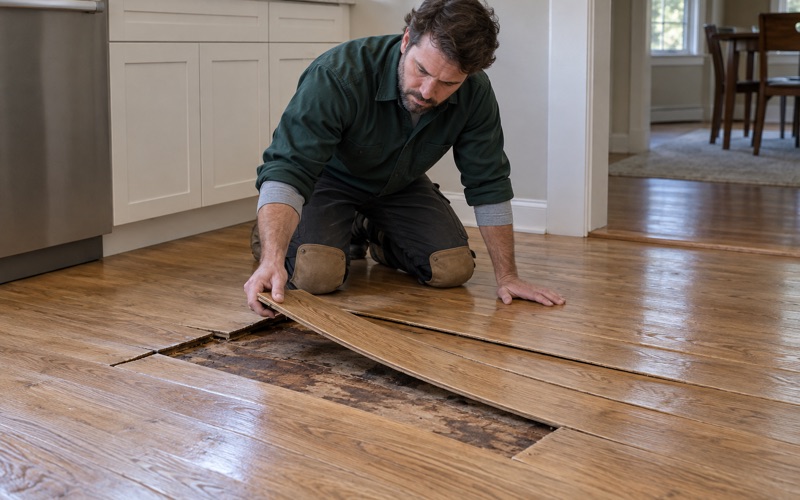
Repair in that stock means board replacement woven into the surrounding field rather than a patch that reads as a patch. We lace new boards in along staggered ends, or cut a dutchman into a damaged area, then sand and finish the whole field so the repair disappears into the floor around it.
What actually fails in an older house
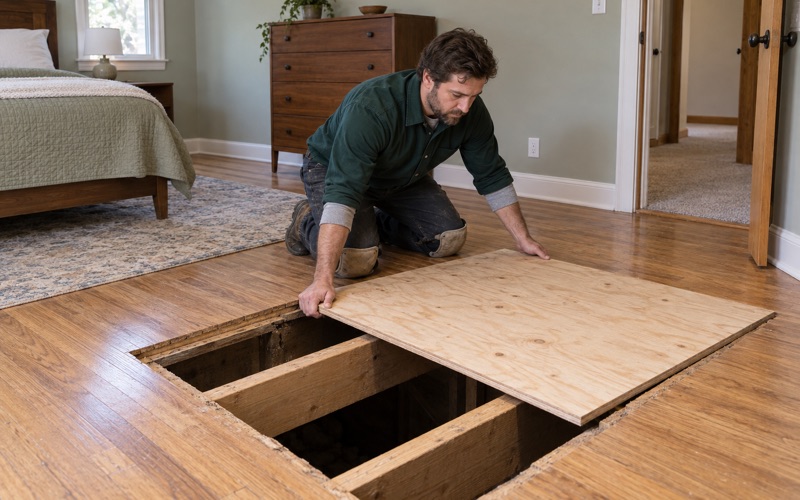
Squeaks and nail pops generally come from the subfloor rather than from the flooring, and they get fixed from below wherever there is access, by screwing the subfloor down to the joists or sistering a joist that has moved. Sanding a squeaky floor does not make it quiet.
Sanding in a house built before 1978 is also different work. The federal lead-safe renovation rule applies to pre-1978 housing, which means HEPA-shrouded sanders, contained work areas and a cleanup standard, and that belongs in the quote rather than surfacing later as an unexplained line.
Below grade, and who governs the job
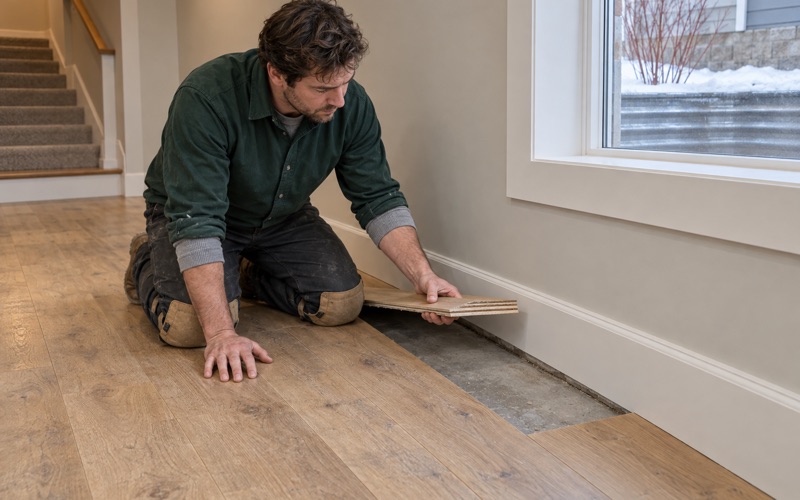
Lower-level work is quoted from a reading taken on the lower-level slab itself, never from the floor above it. A calcium chloride test or an in-situ relative humidity probe on that slab tells us whether a vapor retarder and a particular adhesive are needed, or whether solid wood is off the table down there entirely. Scott County is named in Minnesota Rules 1303.1600 Zone II, where the minimum allowable footing depth for frost is three and one-half feet, so wherever finished space runs below grade the slab reading decides the material.
Sand-and-refinish work is finish work, which Minnesota Rules 1300.0120 exempts from a building permit, so a refinish here is not usually a permit job. Structural subfloor or joist repair is a separate question, and the Minnesota State Building Code as administered by the City of Prior Lake is what governs it.
One jurisdictional point is specific to this city. The Shakopee Mdewakanton Sioux Community, a federally recognized sovereign tribe, holds reservation and off-reservation trust land lying inside the municipal boundary, and that land is not taxable by the city. We make no assumption that answers holding elsewhere in Prior Lake carry onto it, because we have no finding either way that we would be willing to rely on, so on a job there we establish who governs the work before anything is scheduled.
When water gets into one of these older floors, from a failed sump pump or an ice dam, the floor gets photographed and moisture-mapped for the claim before any drying or tear-out begins. Once the boards are gone, nobody can show what was there.
Across all of it the pattern is the one this city’s housing sets. These are floors in homes people keep, so the work is to spend the wood slowly: recoat while there is still finish to screen, repair what can be repaired, and save the full sand for the time it is genuinely earned.
- 20+ Years Experience
- Free Written Quotes
- Moisture Readings on Every Quote