Eden Prairie Wood Flooring has spent more than 20 years installing, sanding and refinishing wood flooring in Richfield and across the south metro. A good share of the calls that reach us from here arrive with a date already attached, a closing, a re-inspection, a tenant move-in, and that date shapes how the whole job gets planned. We would rather tell you what fits inside it than promise a schedule we cannot hold.
That makes the first visit a measuring visit rather than a sales call. We read the indoor relative humidity with a hygrometer and write the number down, we take moisture readings from the flooring and the subfloor separately, and both numbers go on the paperwork before anyone talks about grit or sheen. If the readings say wait, we say so, and we say how long.
Our work here runs from full sand-and-refinish and board replacement to new nail-down installation and a plain screen-and-recoat, and part of the job is telling you which of those the floor actually needs. What follows is how we approach that work when the calendar belongs to somebody else.
The inspection that has to pass before the sale can close
Richfield has run a point-of-sale housing inspection since a 1989 ordinance, which requires every single-family and two-family home, condominiums included, transferring title after October 1, 1990 to be inspected by the City of Richfield Inspection Division, with a Certificate of Housing Maintenance Compliance obtained before ownership transfers. The part that matters to a floor is what happens next. Repairs needed to meet the housing code must be completed and re-inspected before closing, and within one year of the initial inspection date.
That is a different animal from a report handed across the table. The certificate is a condition of closing, so an item written up as a housing-code repair becomes work with a deadline attached rather than a line on a sheet the buyer decides how to feel about. Sellers who have sold a house in another state and assumed the same rules applied here are usually the ones caught short.
What we will and will not tell you about the evaluation
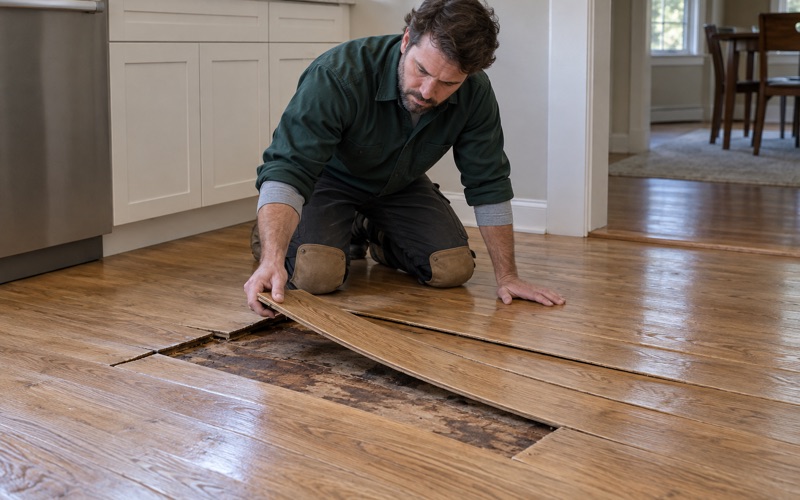
We are a flooring company and not the Inspection Division, so we do not represent what does or does not appear as an item on the city’s evaluation. What we can speak to is the floor. If the inspection produces a required repair that touches wood flooring, a hole, a soft area, a section lifted by old water, a loose or missing stair tread, that repair has to be done and looked at again, and it is worth putting a number on it early rather than in the final days before closing.
The other clock, for rental property
Richfield also licenses residential rental property under City Code Section 407, with an annual inspection and renewals due by December 31, and that inspection covers the interior along with the exterior and common areas. Owners of rental houses and duplexes here therefore live with a yearly interior look rather than a once-per-sale one.
An annual cycle changes what makes sense to spend. A floor that will see several tenancies before the house is sold again is a maintenance question, and we quote it as one. A screen-and-recoat between tenants keeps a finish alive far longer than waiting for it to wear through to bare wood and paying for a full sand.
Looking for wood-flooring closer to Wayzata? See Wood-Flooring in Wayzata.
What the housing code asks of a floor, and what it does not
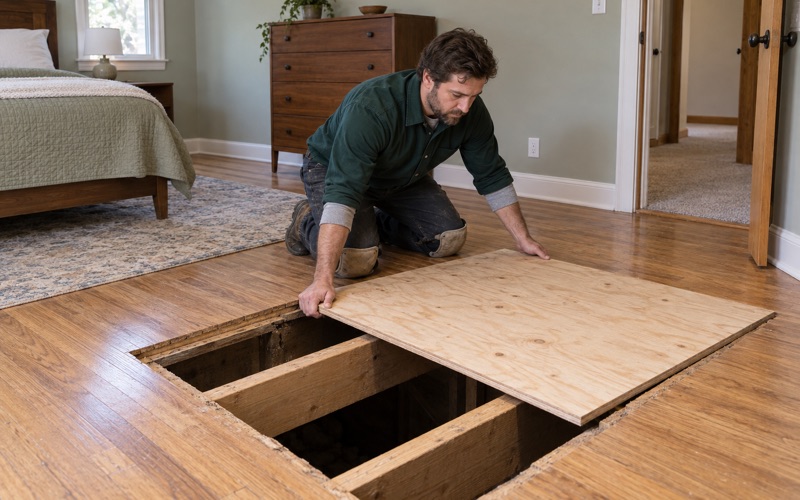
A housing maintenance standard is about soundness and safety, not appearance. Scratches, a dulled finish, pet damage and the gray cast an old coat of waterborne polyurethane takes on are not defects in that sense. A hole, a rotted board, a spongy area over a failing subfloor, an unsecured stair tread or a raised nail head at the top of a flight are a different matter.
That distinction is money. We have walked into houses here where the seller had priced a full sand-and-refinish for a floor whose written repair amounted to two damaged boards by a patio door, and into others where a floor that looked perfectly sound had a soft spot under a rug nobody had moved in years.
Repair and refinish are separate decisions
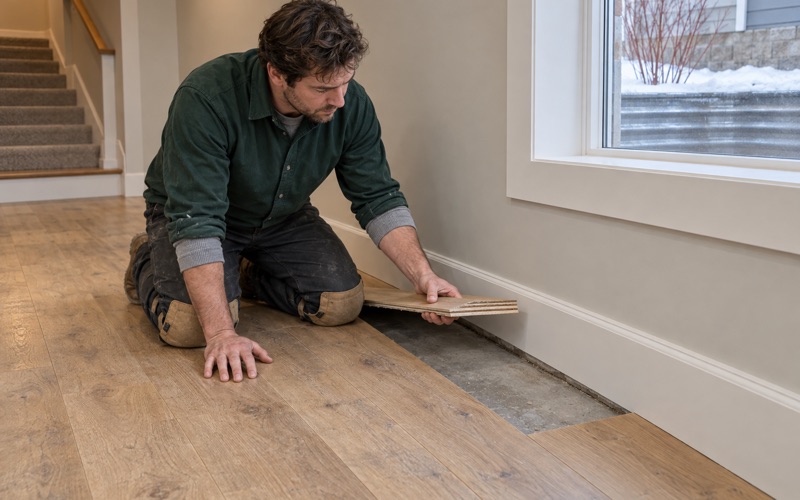
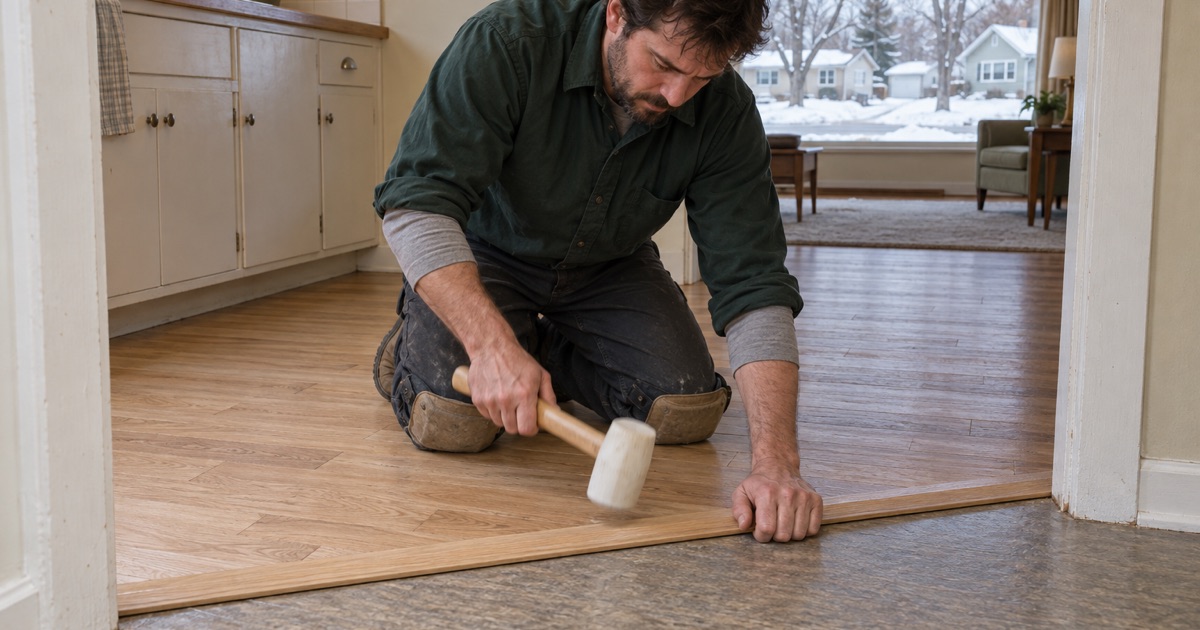
Board replacement, a weave-in at a doorway, a dutchman patch where something was cut through for a register, screwing a subfloor back down to quiet squeaks and nail pops: all of that is repair work, and none of it requires sanding the whole house. We quote the repair alone when the repair alone is what is being asked for. New wood does not match old wood on day one, and we say what the patch will look like against a floor that has aged around it rather than letting it be a surprise.
Permits, and who is allowed to do the work
Interior finish work of this kind sits under the finish-work exemption at Minnesota Rules 1300.0120, so sanding a floor or replacing boards is not usually a permitted job in its own right. Structural repair underneath it is a different conversation, and one to have with the city before anything is opened up.
Residential building contractor licensing in Minnesota is defined at Minnesota Statutes 326B.802, and how a bidder stands under it is a fair question to put before work is scheduled against a closing date. We do not advertise a license or certification we do not hold. What we hand over instead is a written grit sequence and finish schedule with the quote, so the work can be checked against something.
Fixing a floor on a closing date rather than on your own schedule
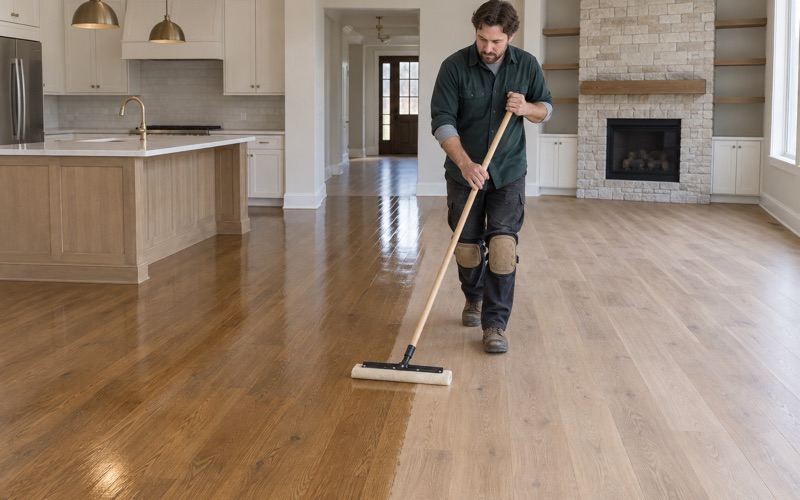
Finish has two timelines and they get conflated constantly. Dry time is when you can walk on the floor in socks. Cure time is when the coating has reached its working hardness and can take furniture, area rugs and a dog, and it is the one that matters when a move-in date is fixed. We put both in writing, along with what a cold house does to them, because a January job in a house at winter temperatures does not behave like the same job in September.
That is also why the coating choice belongs in the schedule conversation rather than after it. A waterborne polyurethane and an oil-modified polyurethane do not reach a furniture-ready state on the same clock, and neither one moves faster because a closing moved up. If the re-inspection and the closing sit only days apart, we would rather tell you that before the machines are rented than after the last coat is down.
The heating season works against you
A heated Minnesota house in midwinter sits below the thirty to fifty percent relative humidity band wood flooring is specified for, which is why we read it and write it down on the first visit instead of handing over a humidifier setting and leaving. There is a genuine conflict to explain here. Push the humidity high enough to keep the floor comfortable through a cold snap and older windows start running with condensation, so you are choosing between two problems and you should get to choose knowingly.
The same season produces seasonal gapping, thin lines opening between boards as they give up moisture, and dry cupping when the face of a board dries faster than its underside. We measure those gaps and photograph them before anyone calls them a defect, because a good share of them close again by June. A floor that is doing what wood does in February is not a floor to sand in February.
Numbers before boards
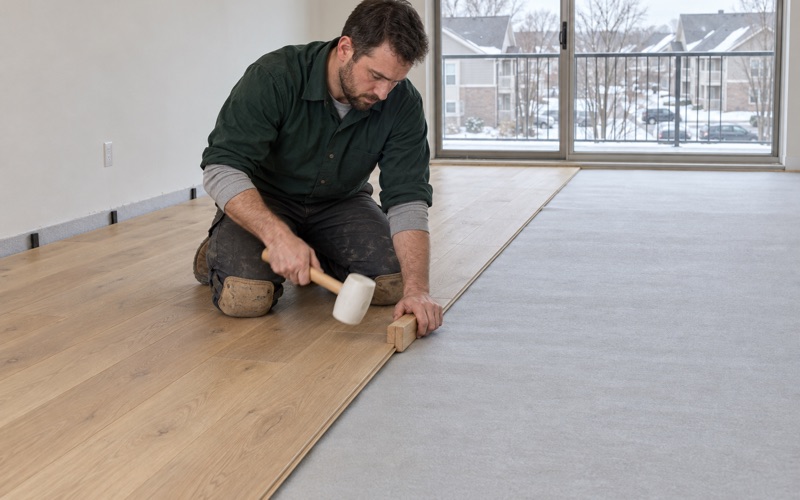
Before a board goes down we measure the moisture content of the flooring and of the subfloor and compare the two against each other, and both readings go on the paperwork. Acclimation is not a number of days on a calendar. It is the point at which those readings sit close enough that the floor can settle to the equilibrium moisture content of the house it is going to live in, and installing across a wide moisture content differential in December is how a floor cups in July.
Seventy-year-old oak, and whether it has anything left to give
Richfield’s housing stock is old in a particular way. Of its housing units, 53.5 percent were built before 1960 and the 1950s alone account for 31.1 percent, the largest single decade by a wide margin. That adds up to a great many modest postwar houses with red oak strip flooring in them, and a good number of those floors are already on a second or third refinish.
Measuring what is left
Solid three-quarter-inch tongue-and-groove has a finite sanding life, and what governs it is how much wood sits above the tongue. Previous sandings have already spent some of that, so we check it before quoting rather than after starting, because a sand-through in a hallway cannot be fixed with more sanding. On an engineered floor we measure the wear layer for the same reason: past a certain thickness there is nothing left to take off, and quoting a refinish on one anyway is how a floor gets ruined.
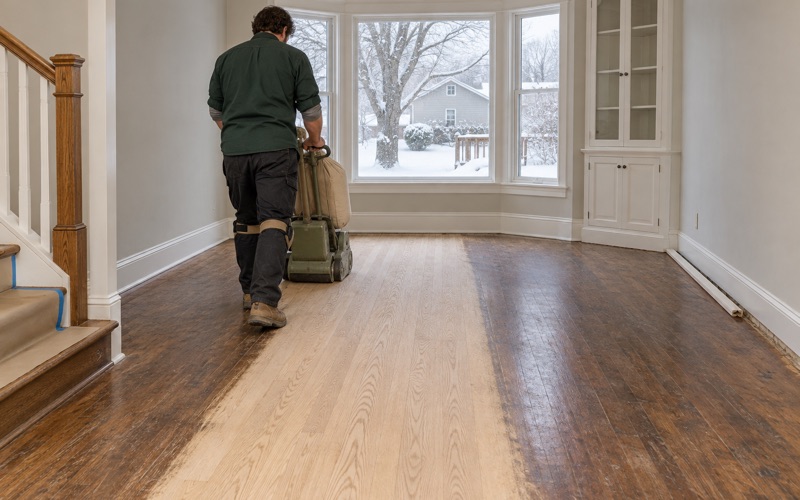
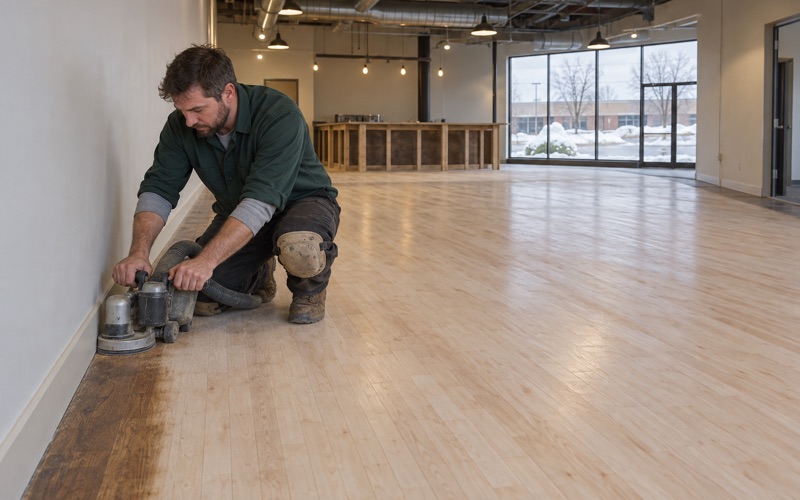
Where there is life left in the boards, the method is not a secret and you should be able to read it before we arrive: a written 36-50-80 grit sequence, a drum sander kept moving so it leaves no chatter marks or drum marks, an edger worked to the same schedule, and a buffer with an abrasive screen before the first coat goes on. Where there is not, or where the finish is worn thin but unbroken, a screen-and-recoat is the honest answer and we say so even though it is the smaller invoice.
Dust, old paint, and the household
With 76.3 percent of the housing here built before 1980, most of these floors sit in homes old enough for the pre-1978 threshold in the EPA RRP lead-safe rule to be a live question, and sanding up to a painted base shoe or a painted stair stringer is exactly where it comes into play. We settle the containment and the HEPA-shrouded equipment before the first machine runs, and we settle the rest of it at the same time: where the furniture goes, where the pets will be, and where the household sleeps while the finish cures.
Old wood is nothing new in this city. The Riley Lucas Bartholomew House at 6901 Lyndale Avenue South was built in 1852 from local lumber, with white pine for its floors, and it was added to the National Register of Historic Places in 1978 and is run today as a museum by the Richfield Historical Society. Floors last when somebody measures before cutting, which is the whole of what we are offering when a closing date is already on the calendar.
- 20+ Years Experience
- Free Written Quotes
- Moisture Readings on Every Quote