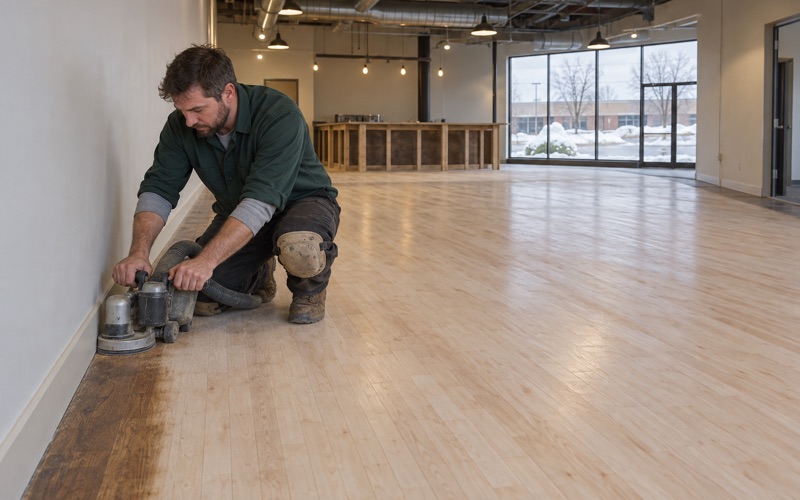
Eden Prairie Wood Flooring has been working on wood flooring in Robbinsdale for more than twenty years, and in this city the opening question on an older floor is rarely which finish to put down. It is how much board is left above the tongue to sand.
That one measurement sets the budget. A floor that has already been taken down three times has a thinner wear layer than it had when it was laid, and no grit sequence, no coating and no amount of care buys that thickness back once it is spent.
So we take the reading before we price anything. We measure what is left above the tongue, we measure the moisture content of the flooring and of the subfloor against each other, and both numbers go on the paperwork — along with a written grit sequence and finish schedule, so the work can be checked against something rather than taken on trust.
A suburb with a genuinely prewar housing stock
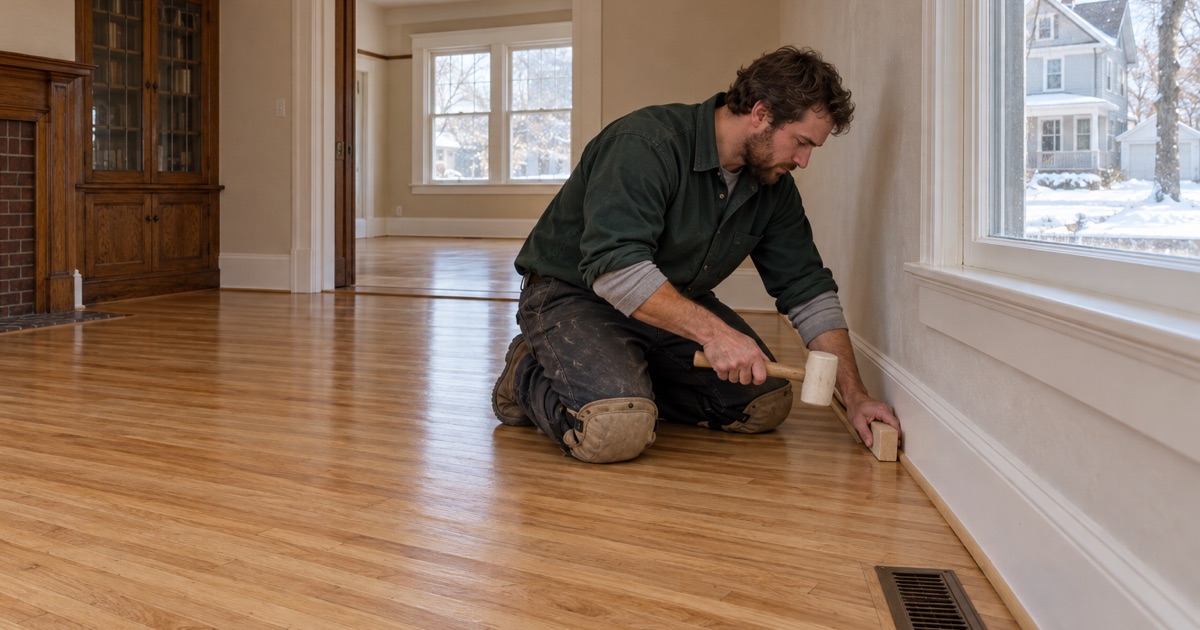
Robbinsdale is old in a way that is unusual for a suburb, and the age shows up underfoot long before it shows up anywhere else. The Robbinsdale Library was built in 1925 and opened on January 4, 1926, and a meaningful share of the houses around it belong to the same generation of construction.
What 14.2 percent before 1940 changes about a quote
Of the city’s 6,523 housing units, 14.2 percent were built in 1939 or earlier and 60.6 percent were built before 1960, by the ACS 2024 five-year estimates in table B25034. The 1950s are the largest single cohort at 24.2 percent, with the 1940s close behind at 22.1 percent, and 76.7 percent of the stock predates 1980.
Those figures describe several different floors rather than one old one. A postwar house usually carries strip oak that was covered by carpet at some point, uncovered later, and sanded once or twice along the way. A house from before 1940 is often on its third or fourth refinish, and that is where remaining thickness stops being a technical footnote and becomes the whole decision.
Lead paint and the pre-1978 rule
Anything built before 1978 falls under the EPA lead-safe rule for renovation, repair and painting, which governs how work that disturbs old painted surfaces is contained and cleaned up. On a flooring job that rarely concerns the field of the floor itself. It concerns the shoe molding, the baseboard, the stair stringers and the thresholds, where decades of paint sit exactly where an edger and a sander have to work.
Because so much of the local stock predates 1978, this is a routine question here rather than an unusual one, and it is worth asking any firm you are considering how they handle containment, dust control and HEPA-shrouded equipment on that kind of house.
A repealed inspection regime that survives as guidance
Robbinsdale once ran a point-of-sale inspection program and no longer does. The city’s own answer to the question is that point-of-sale inspections are no longer required to sell houses in the City of Robbinsdale. It still publishes its Uniform Guidelines, Repair or Replace Lists and Quick Reference materials, but purely as optional resources for an owner who wants to evaluate a house — they carry no requirement behind them.
Two things do still bind. Refinishing an existing floor is finish work, which Minnesota Rules 1300.0120 exempts from a permit, while structural subfloor or joist work is a different matter and goes to the City of Robbinsdale, which administers the Minnesota State Building Code. Separately, any property not occupied by its owner of record — relative-occupied properties included, whether or not rent is paid — carries a Rental Dwelling License under Robbinsdale City Code Housing Code Section 425, on a two-calendar-year cycle with a rental inspection every two years.
Looking for wood-flooring closer to Mendota Heights? See Wood-Flooring Services in Mendota Heights.
Quartersawn and narrow-strip oak, and how to tell what you have
Before a refinish can be priced on a prewar floor it helps to know what the boards actually are. The species, the cut and the width change the sanding plan, the finish and what a single replacement board is going to cost.
Narrow strip, and boards no longer milled to the same profile
The floors in the oldest houses here are usually narrow-strip oak, tongue-and-groove, laid over a board subfloor and fastened with cleats or face nails. They are noticeably narrower than what a supplier stocks today, and the thickness, the face width and the position of the tongue have all drifted over the intervening decades.
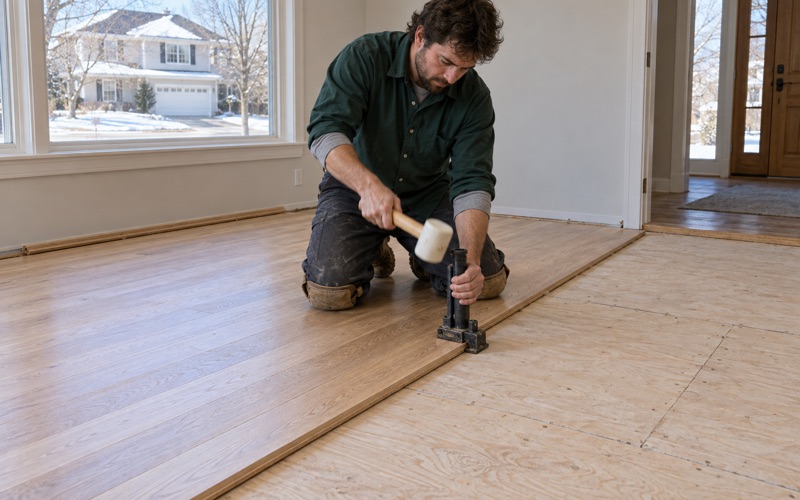
That becomes concrete the moment a board has to come out. New stock set beside eighty-year-old stock rarely meets flush, and the mismatch reads as overwood along the seam until it is sanded flat — which spends thickness the floor may not have to spare.
Quartersawn, rift-sawn and plainsawn grain
Quartersawn white oak and red oak turn up regularly in the prewar houses, and you can read the cut off the face of the board. Quartersawn shows a tight, straight grain with medullary ray fleck across it, rift-sawn shows straight grain with almost no fleck, and plainsawn shows the wide cathedral arches most people picture when they think of oak.
The cut is not decoration. Quartersawn and rift-sawn boards move less across their width as humidity swings than plainsawn does, which is part of why some of these floors have come through eighty Minnesota winters with less cupping than their age would predict.
What the cut changes about sanding and finish
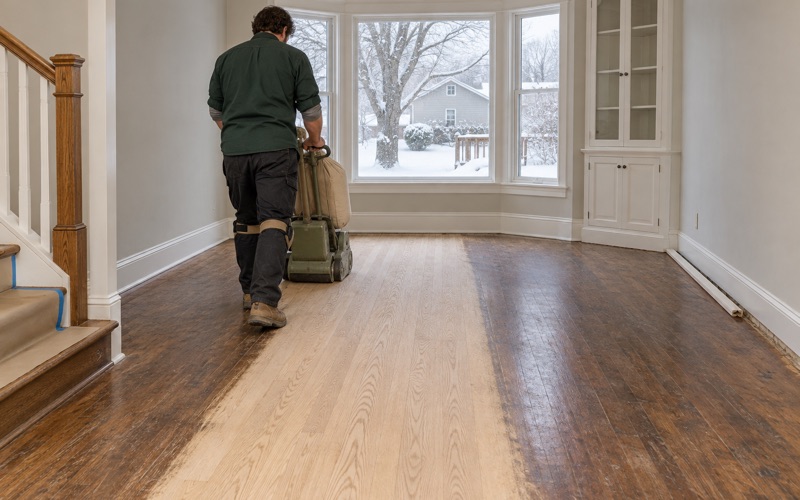
A tight quartersawn face takes stain differently than plainsawn and shows a sanding defect far more readily, because chatter marks, drum marks and swirl marks have nowhere to hide in straight grain. We set the grit sequence around what is actually on the floor rather than a default, and on a thin prewar floor the first cut is chosen to remove as little as the job allows.
Finish selection follows from the same reading. Waterborne polyurethane, oil-modified polyurethane and hardwax oil each shift the color of old oak by a different amount, and on boards that have ambered for decades that difference is obvious in a way it would never be on new material.
How much floor is left after eighty years of sanding
This is the question that decides most jobs in this city, and it is answered with a measurement rather than an opinion. Everything downstream — refinish or recoat, repair or replace — follows from the number.
Measuring the wear layer before anything is quoted
Solid strip flooring can only be taken down to the top of the tongue, and past that the fasteners are in the way and the board has nothing left to hold. We find a place where the edge of the floor is visible — a floor register, a heat run, a threshold, the cut at a doorway — and measure what remains above the tongue.
On an engineered floor the same logic is stricter still, because the wear layer is a veneer over the core and past a certain thickness there is genuinely nothing left to sand. We measure it before quoting a refinish, not after the first pass has already answered the question.
Overwood, sand-through and where old floors fail first
Wear is never even. Doorways, the top and bottom of a stair run and the traffic lane between the kitchen and the back door are thinner than the middle of a bedroom, and a sand-through appears in those places before anywhere else.
The perimeter tells the story from the other direction. A room that has been sanded several times often carries a slight dish through the field and more thickness near the walls, where the drum never reached and only the edger ever worked. That is where an old floor is most often lost, and where a careful operator slows down.
When a screen-and-recoat is the honest answer
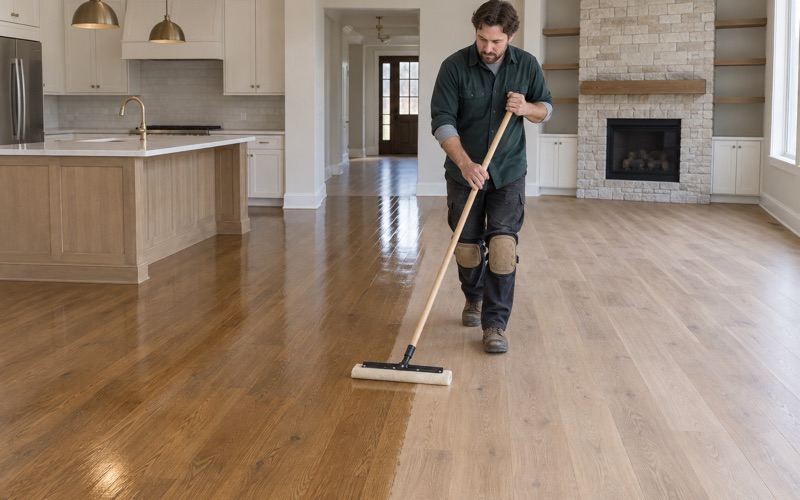
If the existing finish is worn but has not gone through to bare wood, a screen-and-recoat abrades the surface with an abrasive screen and adds a fresh coat without touching the wood at all. On a floor with one refinish left in it, spending that refinish on ordinary traffic wear is a poor trade.
So we quote the recoat against the full sand-and-refinish and say plainly which one we would do, including the times the cheaper answer is the right one. Cure and return-to-service times go in writing as well, with what a cold house does to them, because a coating in a Minnesota January reaches full cure more slowly than the label assumes.
Repairing a floor whose boards are no longer milled
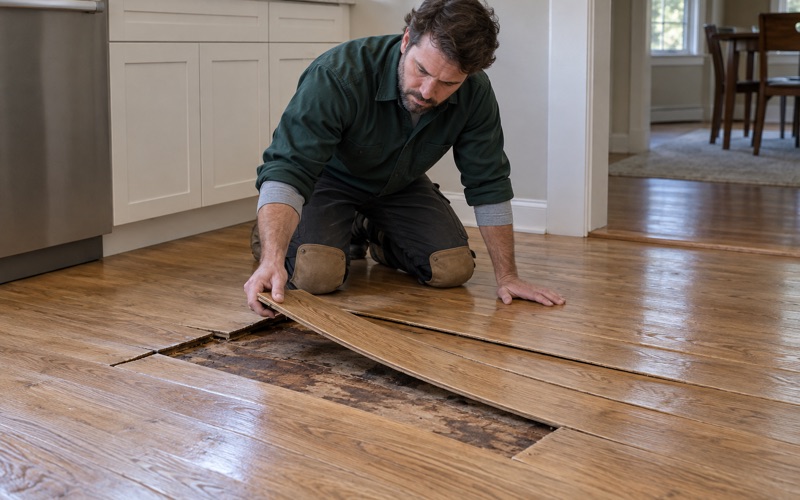
When a prewar floor needs boards rather than a coating, the work is a matching problem first and a carpentry problem second. Water damage, a removed wall, an old register cut or a run of rot at a door all land in the same place.
Weave-ins, lacing and the dutchman patch
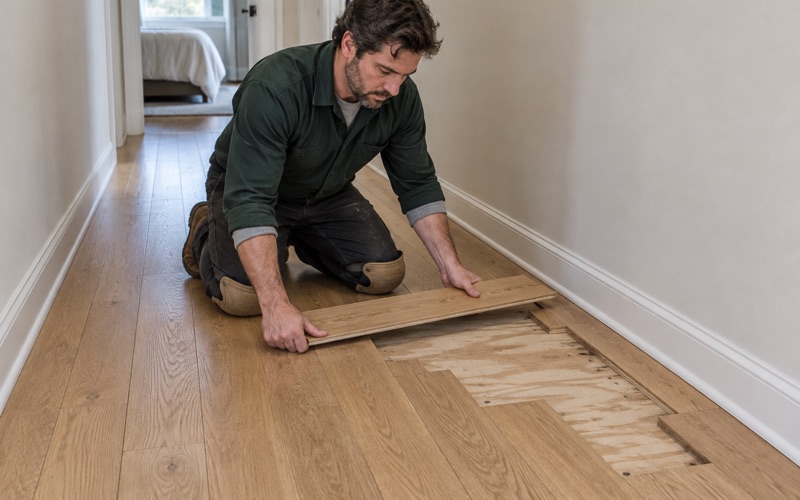
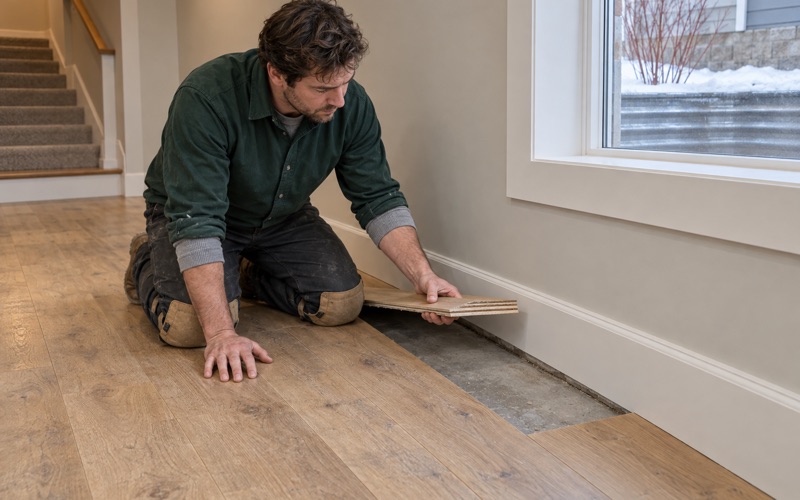
A square patch dropped into an old floor announces itself for the rest of its life. Weaving the replacement boards in — staggering the ends into the surrounding field rather than cutting a clean rectangle — is what makes a repair disappear, and a dutchman patch handles a small local defect without pulling a full board.
Because current stock does not match the old profile, replacement boards frequently have to be milled or shimmed to sit at the right height, and the seam is feathered in from there. On a thin floor we would far rather do that work carefully than sand a whole room down to hide a step at one board.
The subfloor, squeaks and nail pops
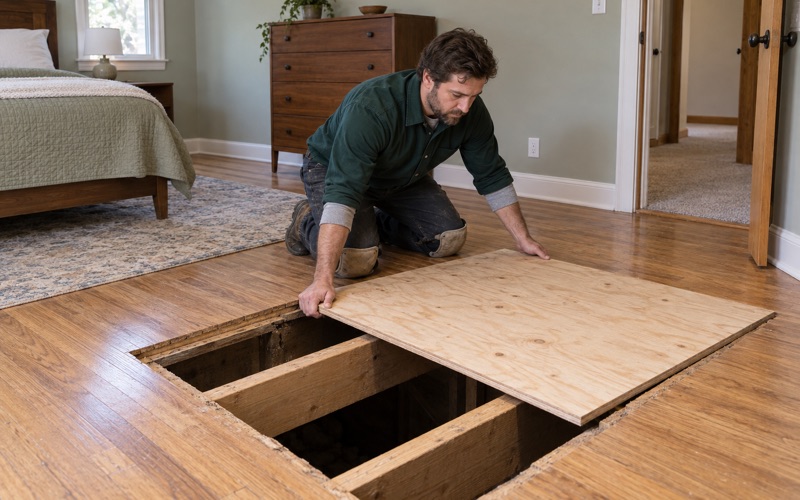
Under the oldest floors here the subfloor is usually board rather than plywood, often laid diagonally, and it has been moving for eighty years. Squeaks, nail pops and soft underfoot spots come from that layer more often than from the flooring above it.
We look for it before quoting, because a subfloor screw-down or a sistered joist is inexpensive while the floor is open and expensive once it has been finished. Any new run gets a fastener spacing schedule planned to the same standard rather than nailed off by feel.
Winter humidity in a heated house
A heated Minnesota house in January sits below the thirty to fifty percent relative humidity band wood flooring is specified for. We read indoor relative humidity with a hygrometer on the first visit and write the number down, because it explains most of what gets called a defect in February — seasonal gapping, dry cupping, a board that has pulled at one end.
A good share of that gapping closes again by June, so we measure and photograph the gaps before anyone calls them a failure. We also name the conflict up front rather than handing over a humidistat setting: running a humidifier high enough to keep an old floor comfortable can put condensation on original windows during a cold snap, and on a house of this age that trade-off belongs in the conversation before the work starts, not after.
- 20+ Years Experience
- Free Written Quotes
- Moisture Readings on Every Quote