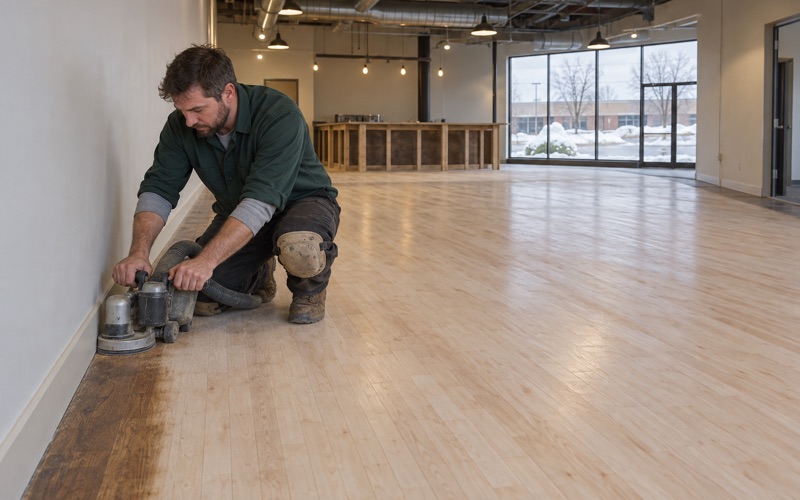
Eden Prairie Wood Flooring has installed, refinished and repaired wood flooring in Shakopee for more than twenty years, and the first question we ask here is not the one we ask in an older suburb. In most houses on this side of the river the floor was never finished on site. It arrived already coated, and that one fact decides most of what can be done to it later.
So the conversation starts somewhere else. Instead of asking when a floor is due for a refinish, we ask whether it can take one at all: how much wood is left above the tongue, and whether a fresh coat will bond to the finish already there. Both are measurements, not opinions, and we take them before we put a number on anything.
A first visit here is mostly instruments and notes. We record the wear layer on an engineered floor, the moisture content of the boards and of the subfloor under them, and the indoor relative humidity on the day we stood in the room. Those numbers are yours whether or not you hire us, because a quote built on anything else is a guess with a price attached.
A city where the finish came from a factory
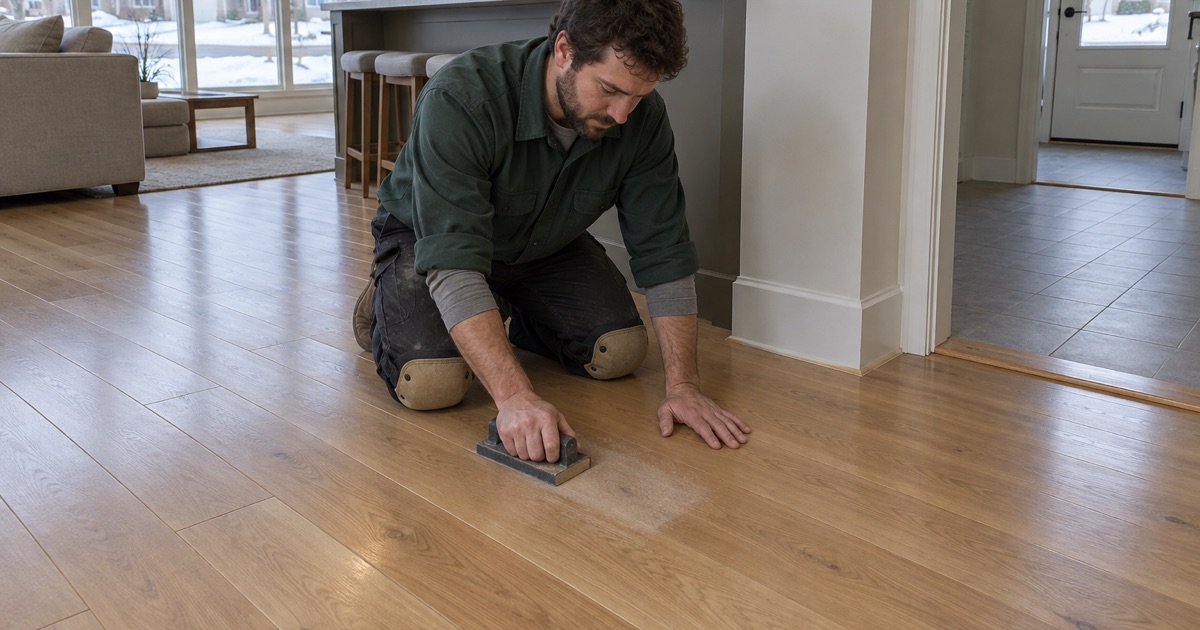
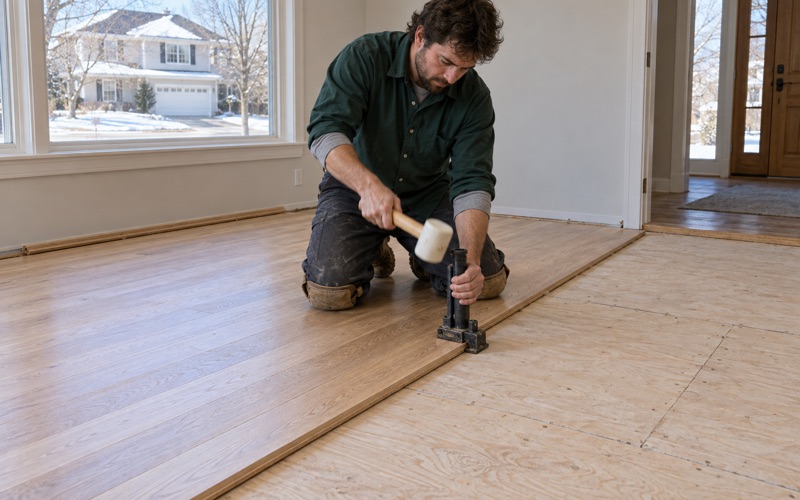
Shakopee’s housing stock is young. 43.0 percent of its units were built in 2000 or later, and the 2000s alone account for 30.7 percent of the 17,216 units in the city, a single decade holding close to a third of everything here. Floors laid in those years were overwhelmingly prefinished: coated, cured and boxed at a mill, then nailed, stapled or glued down and walked on the same week.
A factory-applied finish is not the same material as one rolled out on site. It cures under conditions a house cannot reproduce, it usually sits on a micro-beveled edge rather than a flat field, and it is harder than the polyurethane we would put down ourselves. Homeowners meet that hardness as durability, which it is. What rarely gets mentioned in the showroom is that the same hardness is what makes a later recoat uncertain.
What prefinished changes about a repair
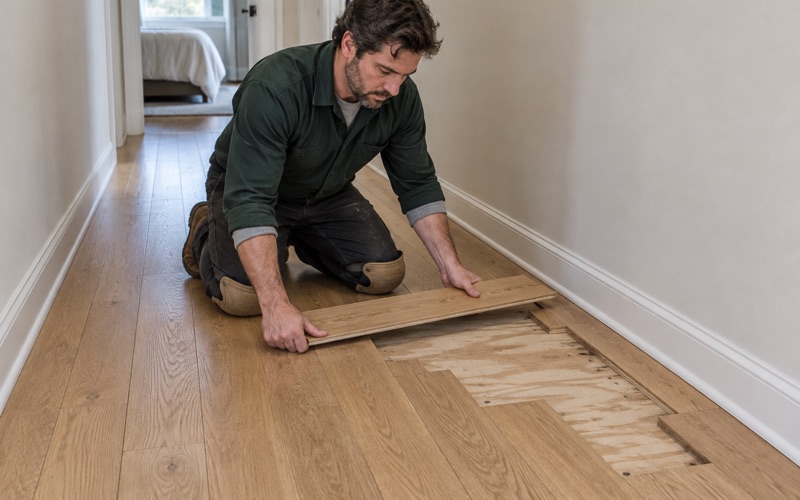
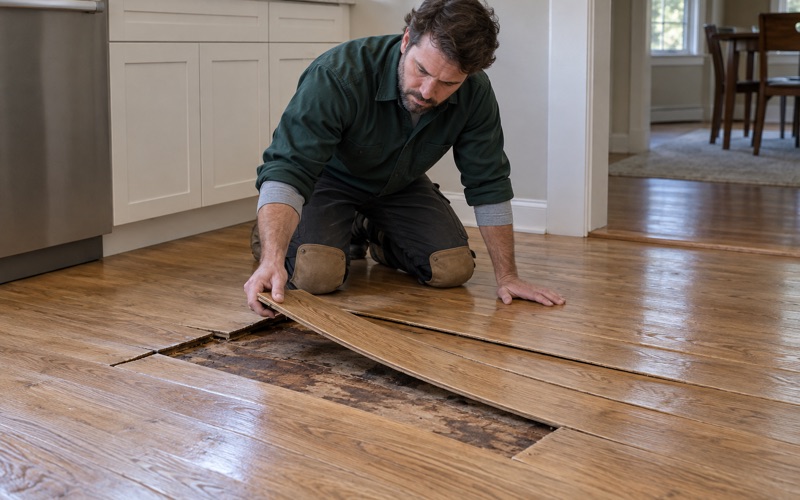
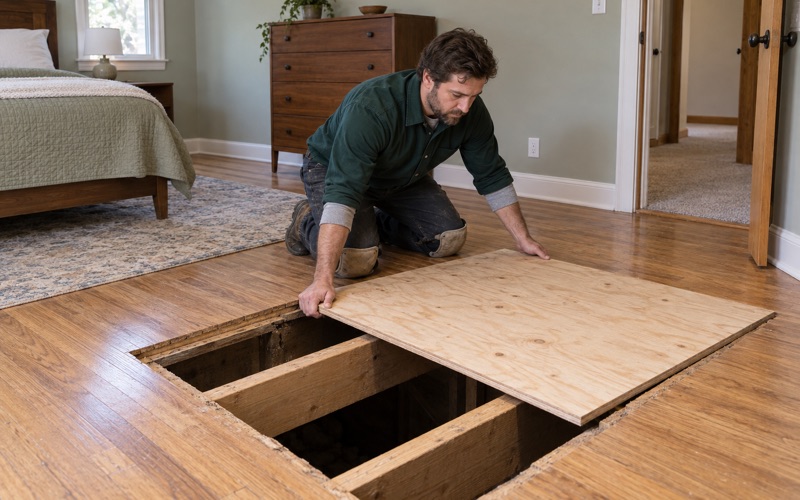
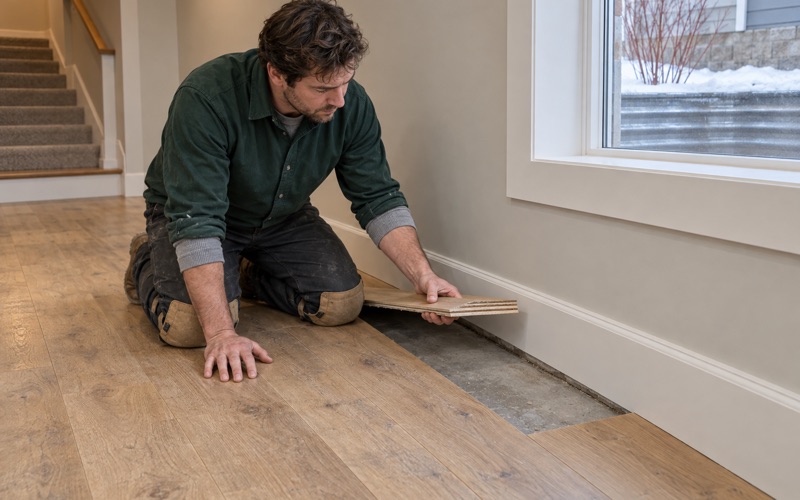
When one board fails in a prefinished floor, whether from a dishwasher leak, a dog door or a dropped pan, the fix is board replacement rather than a sand-and-blend. We cut the damaged piece out, weave a new one in, and the match has to come from the box rather than from a can of stain, because there is no site finish to carry color across the seam.
That makes the leftover carton in your garage worth more than most people assume. Where none exists and the line has been discontinued, we say so before we start, and we talk through lacing new material into a less visible run, a closet or a toe-kick line, instead of leaving a patch in the middle of a living room.
The older fifth of the stock
Not all of the city is new. 21.9 percent of units predate 1980 and 3.0 percent were built in 1939 or earlier, and much of that older housing sits near the nineteenth-century river landing on the south bank of the Minnesota River. The Shakopee Historic District, listed on the National Register in 1972, covers about 76 acres along that bank, and the Early Shakopee Houses on East 2nd Avenue were built around 1865.
Sanding in a pre-1978 house is different work. The federal EPA Renovation, Repair and Painting Rule governs it, Minnesota is not an EPA-authorized RRP state, and containment and HEPA-shrouded sanding change both the schedule and the price. We raise that at the quote rather than on the morning the machines arrive.
Looking for wood-flooring closer to Edina? See Edina Wood-Flooring.
Whether a wear layer can be sanded at all
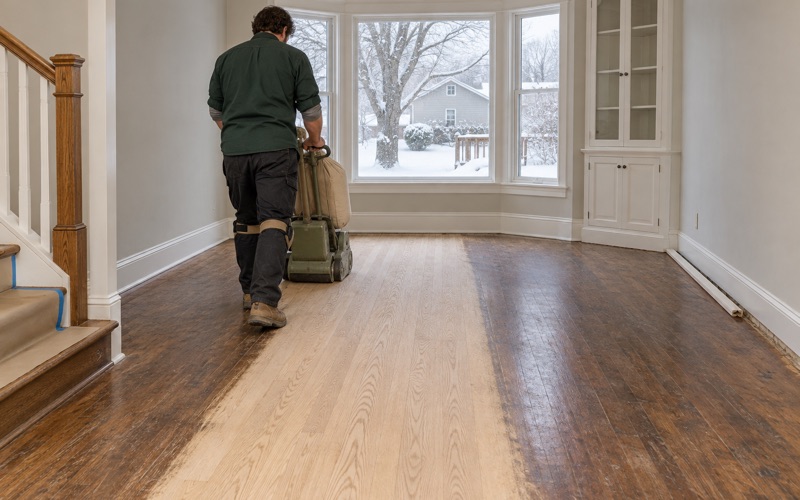
On an engineered floor the only wood anyone can ever sand is the wear layer, the solid veneer sitting over the engineered core construction below it. Once that veneer is spent, a sander reaches plywood, and a floor that reaches plywood is finished rather than refinished. Every engineered floor we look at here is measured first, because past a certain thickness there is nothing left to sand.
Not every prefinished floor is engineered, and the difference decides the whole question. A solid prefinished board is wood all the way down and can usually take a full sand, while an engineered board is a veneer over a core and may have one refinish in it or none at all. We tell them apart the same way either time, by looking at an exposed edge rather than at the top surface.
Where the measurement is taken
An honest reading comes from an edge, not from the middle of a room. We lift a threshold, pull a T-mold or take a board up at a floor vent and measure the veneer above the tongue directly. A manufacturer’s published figure describes the floor as it shipped, and yours may have been sanded once already by an owner who never mentioned it.
Two other readings come off the same inspection: how flat the floor sits, and how much overwood stands at the seams. Together they decide how aggressive the first cut has to be, and the first cut is what spends the wear layer.
What a sand-through costs
A sand-through is not a cosmetic flaw. It is the moment a drum sander or an edger cuts past the veneer and exposes the core, and no coat, color or blend repairs it. The only remedy is replacing boards, and on a thin wear layer the perimeter goes first, because that is where an edger works hardest.
This is why the grit sequence goes into the quote in writing, a 36-50-80 progression with what runs where, rather than being left to a decision made over a machine on the day. It gives you something to check the finished work against, and it commits us to a plan the measurement actually supports.
When a recoat will not bond, and how we find out
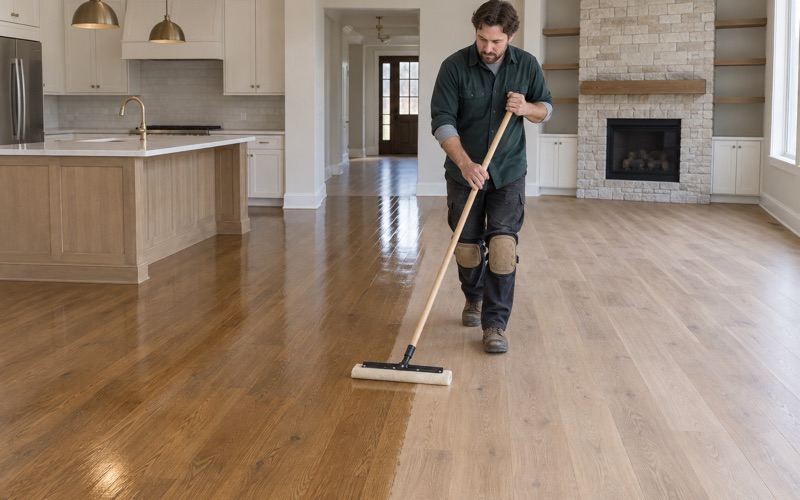
A screen-and-recoat is the fast, inexpensive path: abrade the existing coating with an abrasive screen under a buffer, vacuum, then lay one fresh coat over it. On a site-finished floor that is close to routine. On a factory-applied finish it is an open question, because many of those coatings are formulated for hardness and abrasion resistance rather than for something adhering to them years later.
A test patch before a price
We screen and coat a small area, inside a closet or behind a door swing, and let it cure before anything else is scheduled. If the new coat lifts at a tape pull, or beads instead of flowing out, the answer is no, and more screening will not change it. Learning that in a closet costs a day. Learning it across a main floor costs the floor.
Micro-bevels matter here as well. A recoat sits on top of them, so the seam lines stay visible afterward; if the goal is an unbroken field with no bevels, the floor has to be sanded, which puts us back on the wear layer question.
Sometimes the cheaper answer is the right one
We quote a recoat honestly against a full sand-and-refinish, including the jobs where the cheaper option simply wins. Surface scratching, a dulled sheen level and a wear layer we would rather not spend make a floor a recoat candidate. Staining that has gone through the color, cupping that is still working itself out, or lathe checks opening in the veneer do not, and a coat laid over any of those buys a year at best.
Cure time and dry time are separate numbers and both go in writing, along with what a cold February house does to each, since waterborne polyurethane and oil-modified polyurethane do not behave the same way in those conditions. You also get return-to-service dates for furniture, rugs and pets, because that is the part of a schedule a household plans around.
Measuring the house before a board goes down
Wood flooring is specified for roughly thirty to fifty percent relative humidity. A heated Minnesota house in January sits under that band and stays there for months. We read indoor relative humidity with a hygrometer on the first visit and write it down then, before there is anything to blame it for.
The humidity conversation, stated up front
What the floor wants and what your windows will tolerate are not the same thing. Push a whole-house humidifier hard enough to hold the floor’s band through a cold snap and that moisture finds the coldest glass in the house. We would rather set a humidistat with you and name the trade-off than hand over a number and let you discover the condensation in a bedroom corner.
Seasonal gapping follows the same cycle. Gaps that open in January and close again by June are the floor moving toward equilibrium moisture content, not a defect, so we measure and photograph winter gapping before anybody calls it one. Dry cupping, crowning and compression set are the failures worth acting on, and they read differently from a seasonal gap.
Two moisture numbers, never one
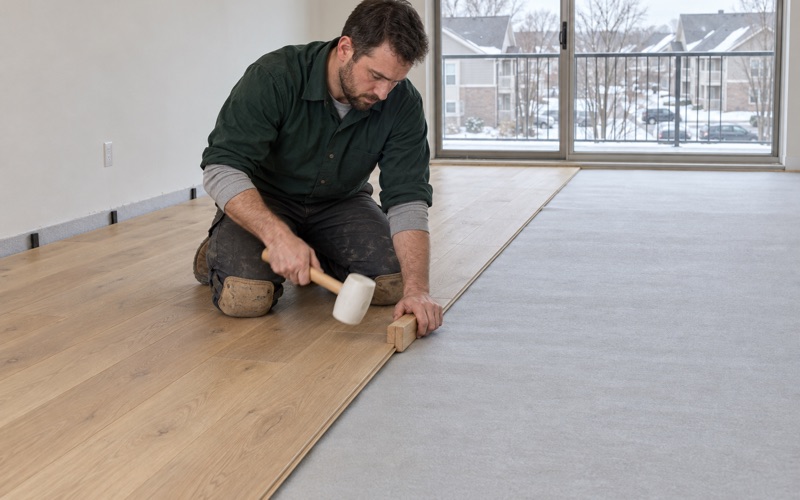
Before installation we take the moisture content of the flooring and of the subfloor with a moisture meter and compare them against each other, and both readings go on the paperwork. The differential between them is what predicts trouble; either figure on its own says very little. Acclimation is what narrows that gap, and NWFA installation guidelines are what we work to while it closes.
Below-grade rooms get their own reading, taken on the lower-level slab itself rather than the floor above it. That is where a calcium chloride test or an in-situ relative humidity probe earns its place, and where the vapor retarder and its perm rating get decided.
Attached homes, and who else signs off
24.8 percent of owner-occupied households here are in attached structures, and townhomes, twinhomes and rowhomes together make up 22.0 percent of all housing units in the city. In those buildings the association’s governing documents usually specify what may go under a hard surface, so we read them and spec the acoustic underlayment to that building before an upstairs job is scheduled. Impact insulation class and sound transmission class are the numbers those documents tend to cite.
On the municipal side, finish work is exempt from a building permit under Minnesota Rules 1300.0120, subpart 4, an exemption that does not authorize work in violation of the code or any other ordinance. The Minnesota State Building Code as adopted and administered by the City of Shakopee still governs the house around the floor. Shakopee is also the Scott County seat, with county administrative offices at 200 Fourth Avenue West, but the sign-off that touches this work is the city’s.
- 20+ Years Experience
- Free Written Quotes
- Moisture Readings on Every Quote