Eden Prairie Wood Flooring has been installing, sanding and repairing wood flooring in St. Louis Park for more than twenty years, and the work here runs against a clock that most of the metro does not set. Before a house is listed for sale, a city inspector walks it, and that inspection does not stop at the roofline or the property line. It comes inside.
That reorders the job for anyone planning to sell. A floor that needs attention is better dealt with while the house is still yours to schedule around than in the compressed window between an accepted offer and a closing date, when every trade in the metro is booked and half the household is already in boxes.
It also changes what a quote has to say for itself. We read indoor relative humidity on the first visit and write the number down, because a heated Minnesota house in January sits below the band wood flooring is specified for, and a floor measured in that condition tells you something a floor glanced at in October does not.
The one inspection around here that comes through the front door

St. Louis Park runs a property maintenance inspection, a point-of-sale inspection, through the City of St. Louis Park Building and Energy Department. It is required whenever an owner, or the owner’s agent, intends to sell or transfer a property, and it has to be done prior to listing rather than somewhere in the middle of a transaction.
The inspector checks that the siding, roof, garage and interior comply with the city’s property maintenance code. The interior is the part that catches sellers out, and it is the reason a floor is worth looking at early here rather than late. A typical inspection runs about forty-five to sixty minutes.
What the certificate does at the closing table
The property maintenance certificate that comes out of that visit must be presented to the buyer and to the title company at closing. It is not a formality filed away in a drawer, it is a document the transaction expects to see, and it carries whatever the inspector recorded about the condition of the house.
Certificates issued for single family homes, townhomes and duplexes are good for one year, and condominium certificates are valid for two. A seller who has the inspection done early and then takes a season to get the house ready is usually still comfortably inside that window.
Do not assume the rules traveled with you
This is a St. Louis Park ordinance, and programs like it are not written to one template from city to city around here. If you sold a house somewhere else before this one, the requirement you remember may have been narrower, or may not have existed at all, and it is worth reading this city’s version rather than the one in your memory.
The same caution applies to owners who are not selling. An annual business license is required before a tenant moves in for any dwelling unit that is not owner-occupied, including single-family homes, duplexes, townhomes and condominiums, so a house being turned over to a renter rather than a buyer sits on an entirely different track.
Looking for wood-flooring closer to Prior Lake? See Wood-Flooring Services in Prior Lake.
What a maintenance code actually reaches in a floor
Condition and safety, not appearance
A property maintenance code is written around condition and safety. It is not a grading rubric for how a floor looks, and the distinction matters because homeowners routinely assume the two are the same thing. A twenty-year-old floor with a dull, tired finish and a floor with a soft spot over a failed subfloor are not remotely the same problem.
So the honest answer to the question every seller asks, whether the floor has to be refinished before the inspection, is usually a question back. Is anything about it loose, broken, buckled or a trip hazard? That is what we look at first, and it is a much shorter list than most sellers expect.
Seasonal gapping generates more anxiety than anything else in February. Gaps that open between boards in a dry, heated house are normal movement rather than damage, and a good share of them close again by June. We measure and photograph winter gapping before anyone calls it a defect, and we say plainly on the occasions when it is one.
Where a wood floor becomes a safety item
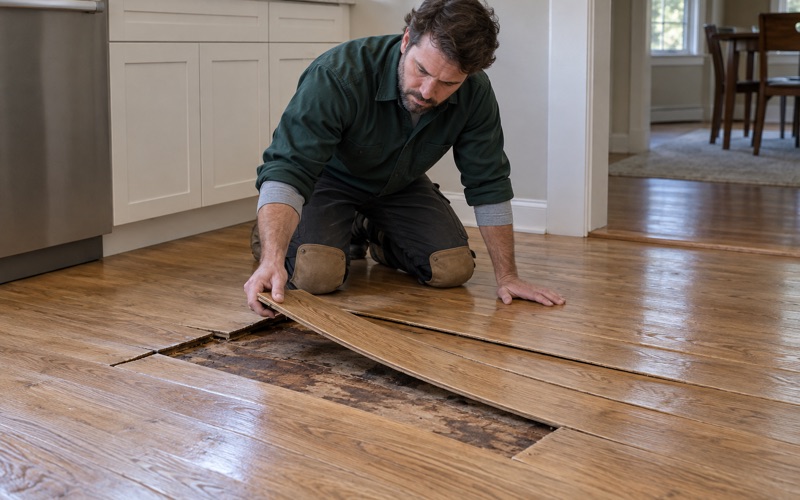
Buckling, meaning boards lifted clear of the subfloor after a water event, is the obvious one. So are nail pops that have worked proud of the surface, a threshold or reducer sitting high enough to catch a toe, overwood at a transition, and a board that has split through its face.
Stairs get their own scrutiny, and for good reason. A loose stair tread, a cracked nosing, a riser that has pulled away from the stringer and a run of treads that moves underfoot are condition questions rather than cosmetic ones, and they are among the easier things to put right before an inspection instead of after.
Repair is very often the whole job
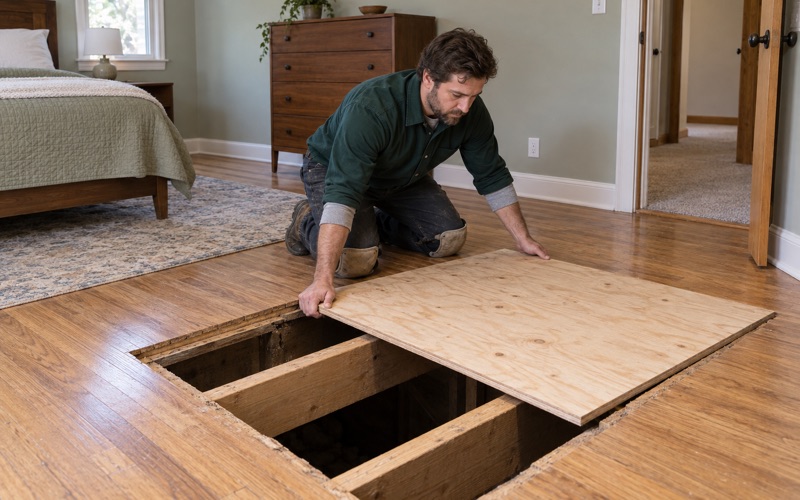
A lot of what we do on a pre-listing floor is board replacement rather than a full sand: cutting out a damaged run and weaving in new material so the joints do not read as a patch, or setting a dutchman patch where one defect sits in an otherwise sound floor. Screwing down a squeaky section fixes a complaint the inspection may never raise but every buyer walking the house will hear.
We measure the moisture content of the new material and of the subfloor against each other before a board goes down, and both numbers go on the paperwork. A weave-in installed wet shows up as a ridge along the seam a season later, long after everyone has agreed the job looked fine.
We also photograph and moisture-map a damaged floor before any drying or tear-out starts, which matters when an insurance claim is part of the story. Once the wet material is out of the house, the evidence has gone with it.
Doing the work before the listing goes up, not after
Finish work is exempt from the permit requirement under Minnesota Rules 1300.0120, subpart 4, item A, which lists painting, papering, tiling, carpeting, cabinets and countertops among the exempt categories. That same subpart states that an exemption does not authorize work in violation of the code or of other laws or ordinances, so no permit is not the same thing as no standard.
What actually governs the calendar is the drying and the curing rather than the sanding. A 36-50-80 grit sequence run with a drum sander, an edger and a buffer takes a fairly predictable number of days. What is less predictable is how long the house needs afterward before the furniture comes back.
Cure time is not dry time, and a cold house stretches both
Waterborne polyurethane and oil-modified polyurethane dry to the touch on very different schedules and cure on different ones again, and a house running cold, which is most houses during a January push to get listed, lengthens the interval. We give cure and return-to-service times in writing, including what a cold house does to them, because walking on a floor and putting the dining table back on it are weeks apart.
We plan furniture, pets and where the household sleeps before the first machine runs. On a house being staged for photographs on a fixed date, that plan is the whole difference between a schedule and a hope.
A recoat quoted honestly against a full sand
A screen-and-recoat, meaning the existing finish is abraded with a buffer and an abrasive screen and a fresh coat goes over it, costs a fraction of a full sand-and-refinish and disrupts the house for a fraction of the time. On a floor whose finish is worn but not worn through, it is simply the right answer, and we say so even when saying so costs us the larger job.
It is not the right answer on a floor with sand-throughs, with water staining that has gone down into the wood, or with a wax history that will reject a coating. On an engineered floor we measure the wear layer before quoting a refinish at all, because past a certain thickness there is nothing left to sand and a quote that ignores that is a quote for a ruined floor.
A written grit sequence and finish schedule
The quote goes out with the grit sequence and the finish schedule on it: how many coats, which product, what sheen level. That gives you something concrete to check the finished work against, and it gives whoever touches the floor next a record of what is already on it.
Narrow-strip oak under carpet in a postwar house
A large share of the city’s housing predates the era when carpet went down over everything. The 1950s are the single largest build decade in St. Louis Park at 23.6 percent of its housing units, and 44.4 percent of them were built before 1960. Pulling back carpet in one of those houses very often uncovers narrow-strip oak sitting under the pad in original condition.
What usually survives, and what does not
The board itself is normally fine. Two-and-a-quarter-inch red oak laid tight in the 1950s is a better floor than a great deal of what is sold today, and it usually has enough thickness left for a full sand. What needs attention is the perimeter, where tack strip has left a line of nail holes, and any doorway where a threshold or a reducer was fitted to carpet height instead of wood.
Sanding an original floor is also where a drum sander earns its reputation. Chatter marks, drum marks and edger swirl are what a rushed job leaves behind, and all three stay visible under low-angle light long after the crew has packed up. Dustless sanding keeps the rest of the house livable while the work is going on.
Paint, lead and a pre-1978 house
Minnesota is not on the EPA list of authorized Renovation, Repair and Painting states, so the EPA administers the RRP program here, and federal firm and renovator certification governs renovation that disturbs paint in pre-1978 housing. If a job involves pulling base shoe or molding off the wall, that rule is in play, and how it is handled is a fair question to put to anyone quoting the work.
The lower level is a different floor
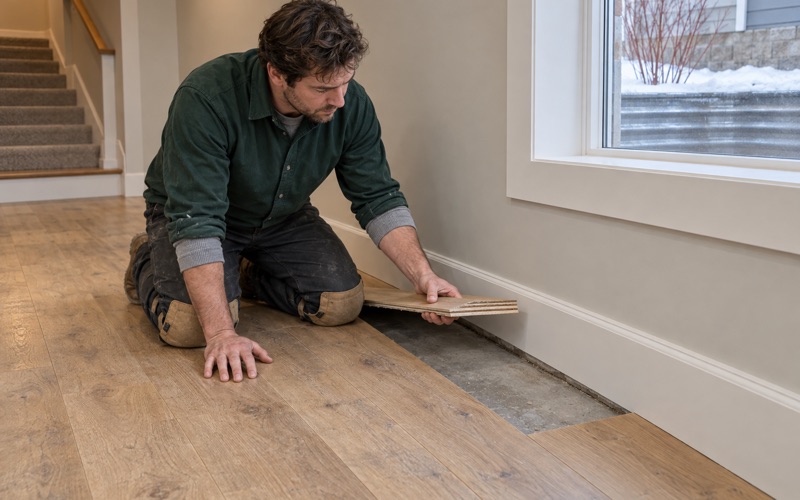
A finished lower level is a separate question from the main floor, and we quote it from a reading taken on the lower-level slab itself. That means a calcium chloride test or an in-situ relative humidity probe run in the slab, never a number borrowed from the floor above it, because a slab in contact with soil behaves nothing like a joisted floor over a conditioned space.
That reading decides whether a vapor retarder belongs in the assembly and what perm rating it needs, and sometimes it decides that a solid floor does not belong down there at all. We take it before quoting rather than after a problem appears.
Who is actually living in the house
Owner occupancy in St. Louis Park runs at 57.8 percent of occupied units, and 78.8 percent of those owner-occupied units are one-unit detached houses. The typical pre-listing floor here therefore sits in a single-family house the seller is still living in, which is why the sequencing above is not academic. The work has to happen around a household that has nowhere else to be.
- 20+ Years Experience
- Free Written Quotes
- Moisture Readings on Every Quote