Eden Prairie Wood Flooring has been installing, repairing and finishing wood flooring in Victoria for more than twenty years, and the work here looks different from what we do in the older parts of the metro. Most of the floors we are called out to in this city are not worn out. They are young, the original paperwork is usually still in a drawer somewhere, and the question in front of the homeowner is whether what they are seeing is a defect, a site condition, or ordinary seasonal movement.
That changes what a first visit is for. Instead of assessing a finish that has been walked on for forty years, we are measuring air, subfloor and board, and writing those numbers down so there is a record of what the floor was doing on the day someone first called it a problem.
We quote board replacement, recoats, repairs and full installations, and we say plainly when the cheaper answer is the right one. Any sanding quote leaves here with a written grit sequence and finish schedule attached, so the work can be checked against something rather than described after the fact.
A city whose floors are still young
The single largest build decade in Victoria is the 2010s, at 31.6 percent of the city’s 4,230 housing units, and 62.3 percent of everything here went up in 2000 or later. Only 13.8 percent predates 1980. A wood floor in this city is far more likely to be inside its original documentation than at the end of a service life.
The city describes itself as the City of Lakes and Parks, caretaker of twelve lakes and more than 400 acres of reserved land along the southwest edge of Lake Minnetonka, with growth of over forty percent in the last ten years. Growth at that rate shows up underfoot: subdivisions finished within a few years of one another, similar subfloor construction, similar heating equipment, and floors all arriving at their first real decision at roughly the same time.
An owner-occupied city, and what that changes
93.6 percent of occupied housing units here are owner-occupied. The practical effect is that the person who noticed the gap in February is usually the same person holding the installation invoice, the product name and the date the floor went down.
That is worth more than it sounds. When we can read what was installed and when, the repair conversation starts from the actual floor instead of a guess about species, wear layer and finish.
The older houses, in smaller numbers
Not everything here is new. 5.0 percent of units were built before 1960, and those houses ask different questions: board widths that no longer match anything on a shelf, and subfloors that want screwing down before anything is laid over them. We quote that work as its own job rather than pricing it like the newer stock.
Attached homes and the documents that govern them
11.7 percent of the city’s housing units sit in attached structures of two or more units. Before we schedule an upstairs job in one of those, we read the association’s governing documents and specify the underlayment to that building, because impact insulation class and sound transmission class requirements appear in declarations and bylaws far more often than owners expect.
Looking for wood-flooring closer to Orono? See Orono Wood-Flooring.
What a wood floor’s warranty actually turns on
We will not tell you what your manufacturer’s document says. Those vary by product, by line and by year, and the only authoritative copy is the one that came with your floor. What we can tell you is the category of condition nearly all of them are built around, because it is the same category that decides whether a floor behaves at all: the moisture in the air, and the moisture in the material.
The humidity band and a Minnesota January
Wood flooring is manufactured and specified for a service environment in the neighborhood of thirty to fifty percent relative humidity. A heated house in this climate sits below that band for months, and the floor answers by giving up moisture, shrinking across the grain and opening seasonal gapping at the board edges.
So we read indoor relative humidity with a hygrometer on the first visit and write the number down. A floor assessed without that reading is being judged with the main variable missing.
We also explain the conflict up front instead of handing over a humidistat setting and leaving. Running a whole-house humidifier hard enough to hold the floor’s preferred range can put condensation and frost on window glass during a cold snap, and the right setting is a compromise between the floor, the windows and the wall assembly rather than a number lifted off an installation sheet.
Gapping in February is not automatically a defect
Before anyone calls seasonal movement a defect, we measure the gaps and photograph them, with the date and the humidity reading attached. A good share of what looks alarming in February has closed on its own by June, and a complaint built on the winter condition alone describes a floor that no longer exists.
The failures that do not close are different in shape, and they have names. Dry cupping across the width of a board, crowning where a cupped floor was sanded flat too early, buckling where an expansion gap was lost, compression set where swollen boards were forced against each other. We say which one we believe we are looking at, and what the evidence for it is.
Keeping the record a claim needs
When a floor is damaged by water, whether from a supply line, a sump pump failure or an ice dam backing up into a wall, we photograph and moisture-map it before any drying or tear-out begins. Once the fans have run for two days, the condition that would have supported the claim is gone. That same record is what settles the like kind and quality question, which is where most flooring claims are actually decided.
Replacing a damaged board instead of sanding a whole floor
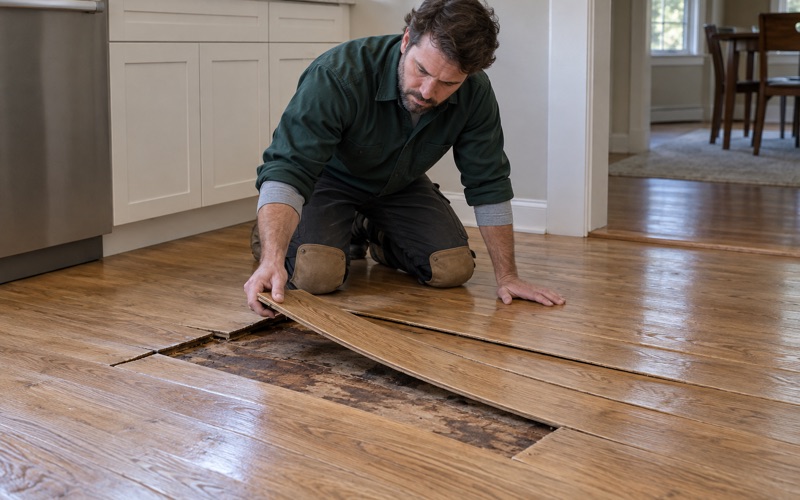
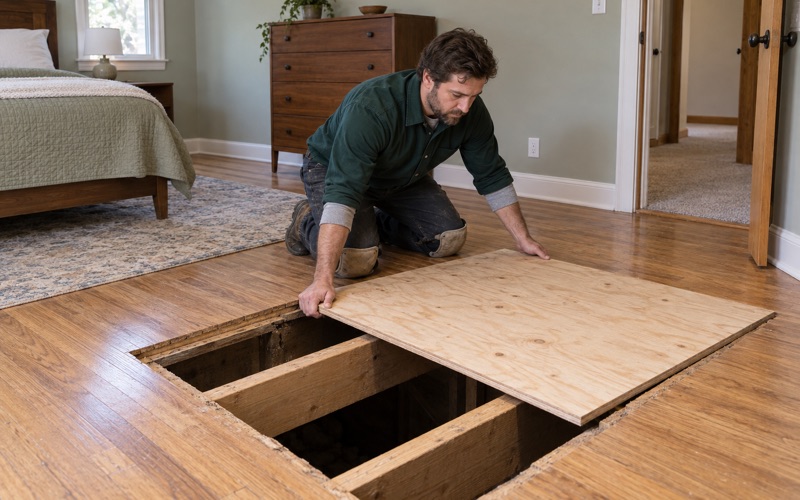
On floors this young, a whole-floor sand is usually the wrong tool. A scratched hallway, a dishwasher leak under two rows, a stair nosing taken out by an appliance on the way through: these are local problems, and the right repair is local as well.
Weave-in, lacing and the dutchman patch
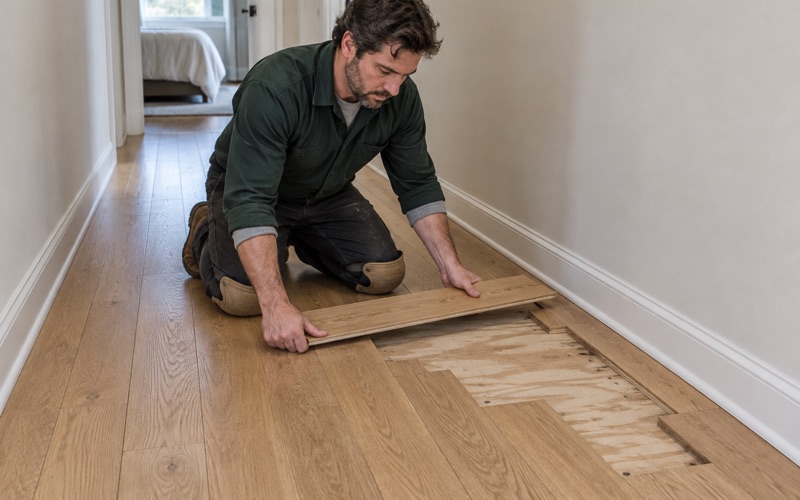
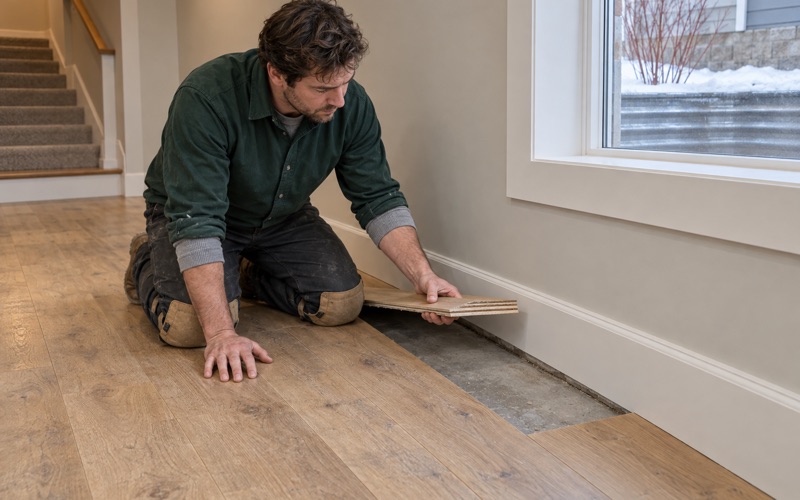
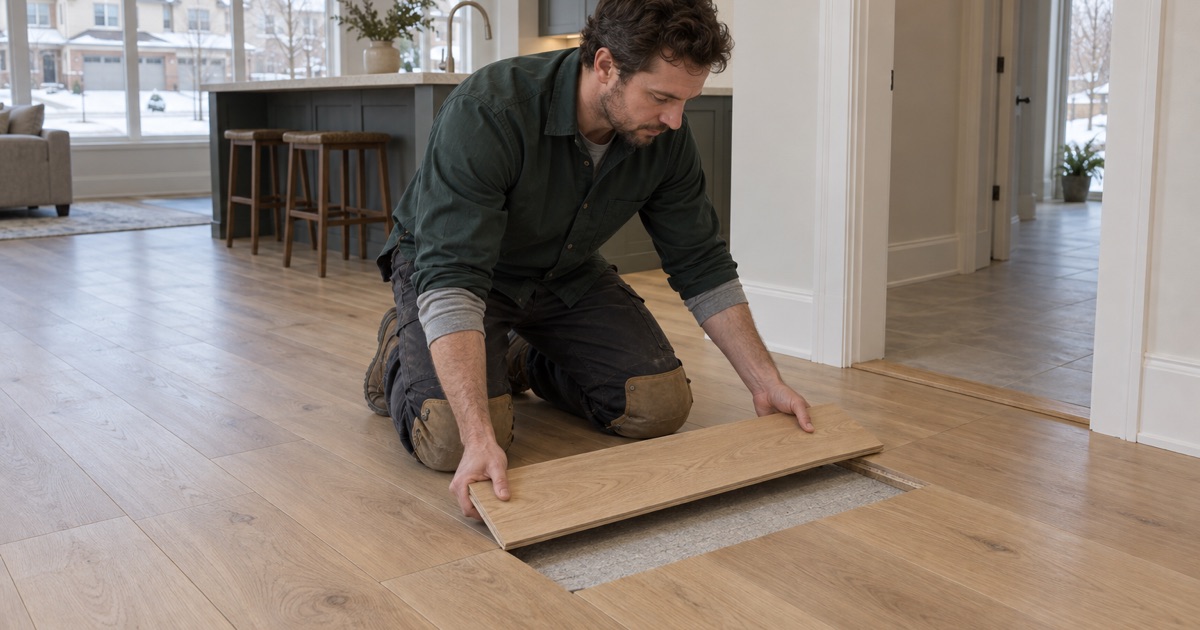
A proper board replacement is woven into the surrounding field so the end joints stagger the way the original installation did. A straight-cut patch reads as a rectangle in the floor for the rest of its life; a weave-in reads as floor. Where only part of a board is compromised, a dutchman patch can save the rest of it.
Matching matters more than the carpentry. Species, grade, board width, sawing method and sheen level all have to line up, which is why the installation paperwork so many houses here still have is worth finding before anything is ordered.
Prefinished floors and the edge you can feel
Most of what went down in this city over the last fifteen years is prefinished, with a micro-bevel at each edge and a factory finish no site process reproduces exactly. Replacement boards from the same line usually blend well. A discontinued line turns into a real conversation: a blended repair using boards pulled from a closet, against refinishing a whole room to one new common finish.
Wear layer decides what is possible on an engineered floor
Engineered core construction is not all the same, and the number that governs the decision is the wear layer. We measure it before quoting any engineered floor for a refinish, because past a certain thinness there is nothing left to sand and the honest answer is board replacement or a recoat.
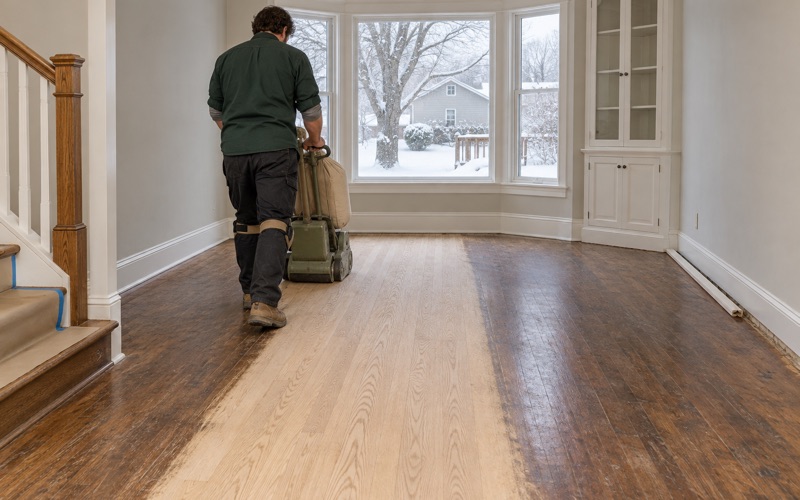
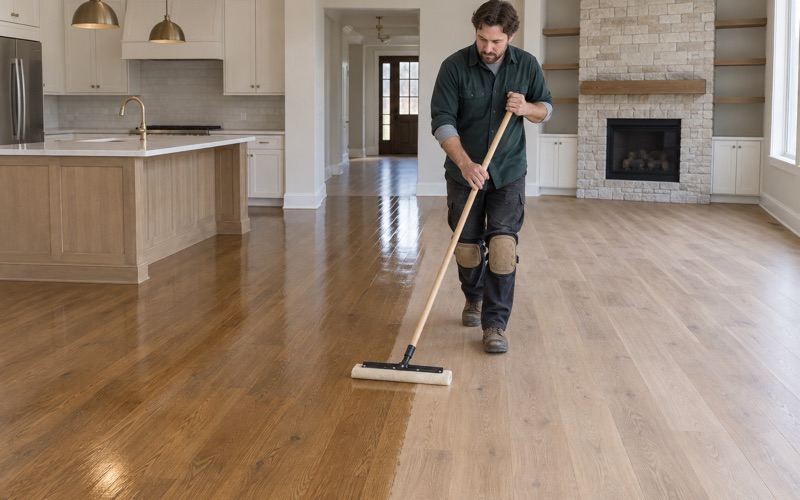
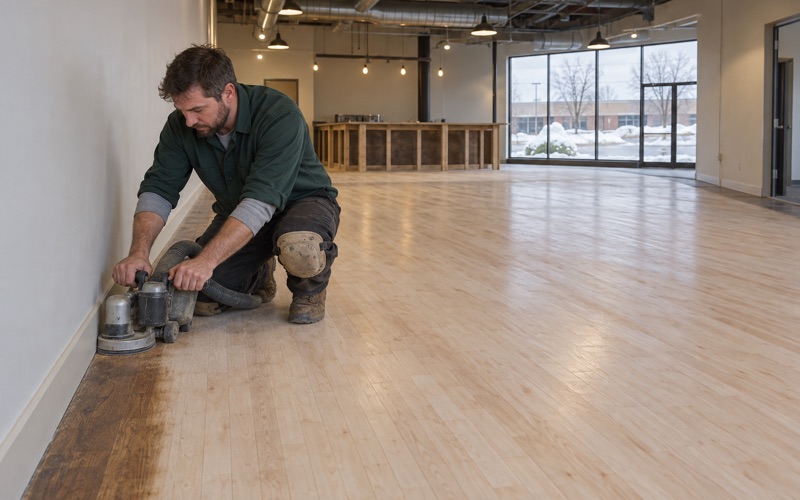
A screen-and-recoat, abrading the existing finish with an abrasive screen and laying a fresh coat over it, is often the right answer on a floor with an intact wear surface and no deep damage. We quote it against a full sand-and-refinish with the 36-50-80 grit sequence written out, and we say which one we would choose, including the times the cheaper one wins.
Who administers the code on a repair
Work inside the house falls under the Minnesota State Building Code, administered here by the City of Victoria Building Department. Flooring is ordinarily finish work under the Minnesota Rules 1300.0120 permit exemption, but structural repair to a subfloor or to joists is not, and we say which side of that line a job sits on before it starts.
Acclimation on a new installation, measured rather than timed
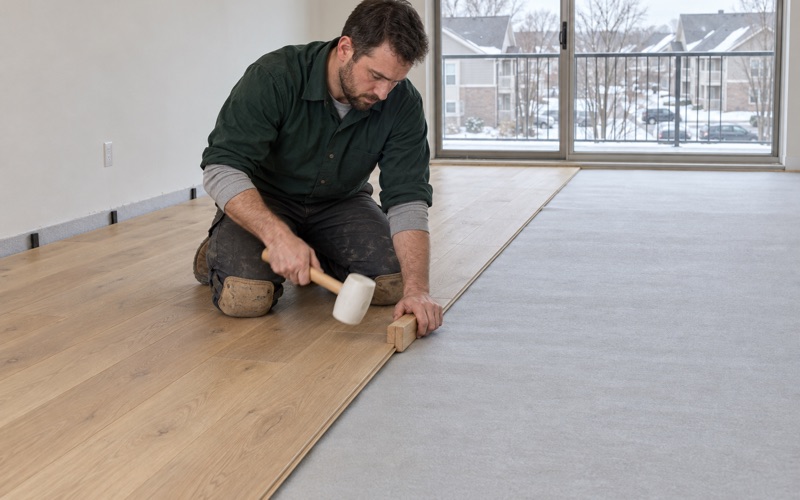
Acclimation is not a number of days on a calendar. It is a condition: the flooring and the subfloor reading close enough to one another, in the house’s own service environment, that the boards will not move much once they are fastened down.
The differential, and the number of readings
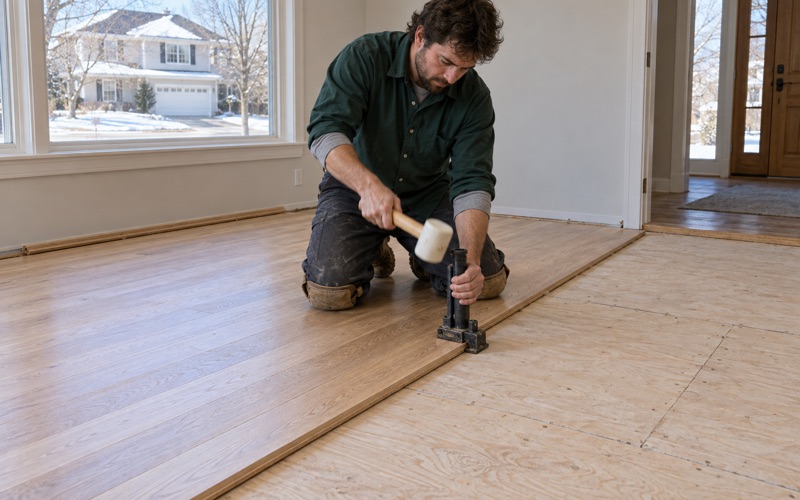
The NWFA installation guidelines put that in numbers. No more than four percent moisture content difference between subfloor and flooring, no more than two percent for a nail-down installation over plywood, and roughly twenty test points per thousand square feet.
We take both sets of readings with a moisture meter before a board goes down, and both numbers go on the paperwork. A floor installed to a delivery date instead of a differential is the most common avoidable failure in this trade, and it usually surfaces as cupping through the first humid summer.
Lower levels, slabs and the reading that counts
Carver County is named in Minnesota Rules 1303.1600 Zone II, where the minimum allowable footing depth due to freezing is three and one-half feet. That depth is a large part of why finished lower levels are normal in houses here, and why so much of our below-grade installation work sits on a slab rather than a framed floor.
A below-grade quote comes off a reading taken on the lower-level slab itself, using an in-situ relative humidity probe under ASTM F2170 or a calcium chloride test, and never off the conditions on the floor above it. The vapor retarder and its perm rating are specified from that number rather than from a default.
Since 2009 all new homes in Minnesota have been required to be built radon-resistant, so lower levels in the newer part of the city often carry a passive system running through the slab. We work around the pipe and its seal instead of cutting into either one.
Cure time, dry time and a cold house
Dry time is when you can walk on it. Cure time is when the finish has reached its full hardness, and the two are not close together, with waterborne polyurethane, oil-modified polyurethane and hardwax oil each keeping their own schedule.
A cold house stretches both, which matters from October through April. Return-to-service times go out in writing, covering walking, furniture, rugs and pets, and we plan where the household sleeps and where the furniture goes before the first machine runs rather than working it out on day two.
- 20+ Years Experience
- Free Written Quotes
- Moisture Readings on Every Quote